

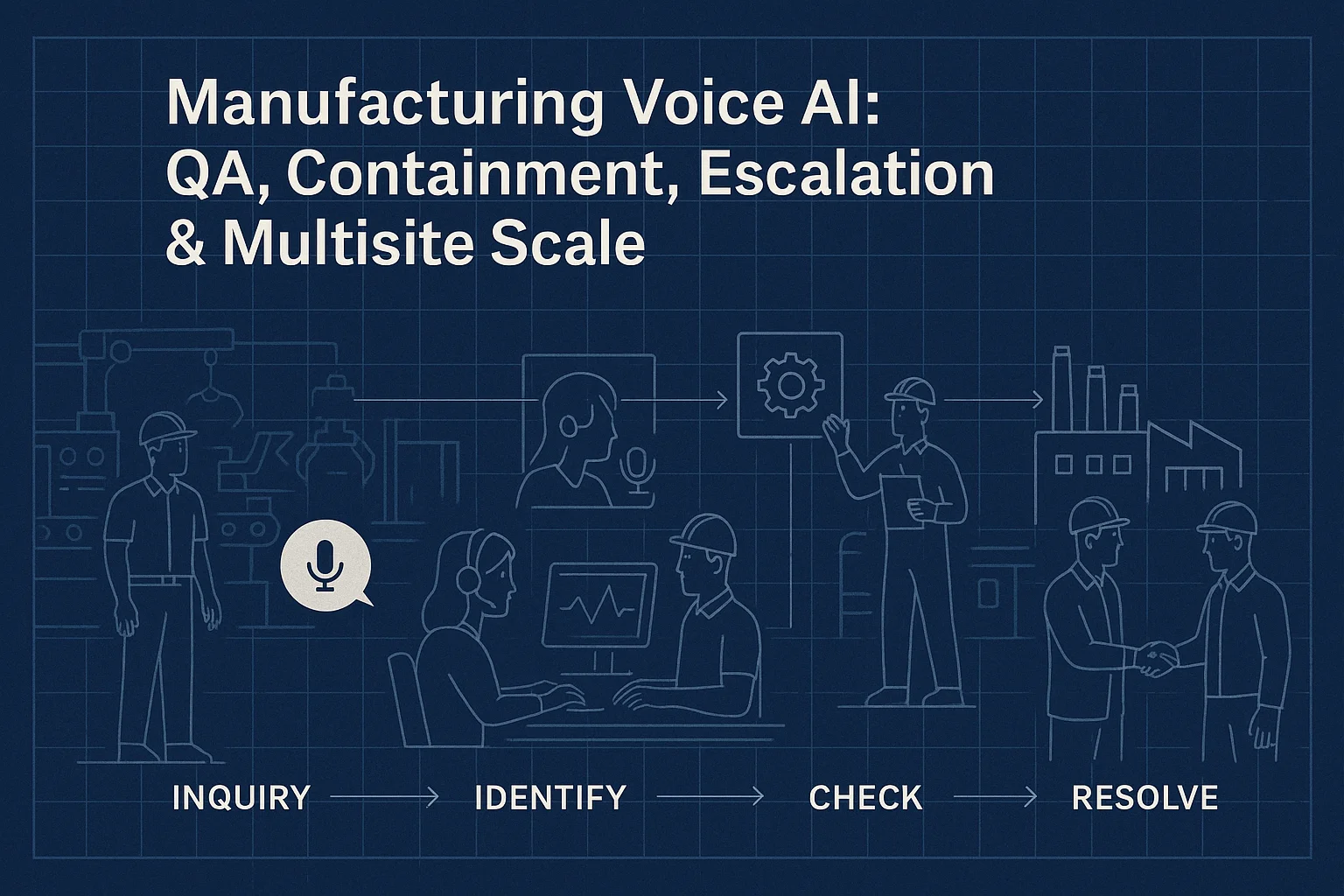
Manufacturing Voice AI: QA, Containment, Escalation & Multisite Scale
Practical guidance for deploying Voice AI in manufacturing service, warranty, and parts workflows: QA design, containment quality, escalation controls, multisite and multilingual scale, analytics, and procurement considerations.
1. Where Voice AI Earns Its Place in Manufacturing
Voice AI is not a replacement for domain expertise; it is a precision tool for front-line validation, intake, automated routing, and low-risk self‑service. To be operationally useful, engineering and service leaders must place hard boundaries around automated decisions and integrate the system with ERP, CRM, warranty, and service APIs.
Voice AI use cases that pay off
Prioritize call types that are high-volume, predictable, and low-risk to automate. Typical early wins in manufacturing include parts identification and availability checks, order and shipment status, routine maintenance scheduling, basic triage questions that collect machine model, serial number, and observed fault codes, and intake of warranty/service tickets with human approval gates. Avoid automating engineering or safety decisions without human controls; use Voice AI to collect structured evidence for a human reviewer.
- Parts lookup and stock check using SKU/part number or VIN/serial number.
- Order and shipment status with ERP/OMS validation.
- Warranty intake templates that capture covered asset, purchase date, observed failure and photos/recordings for human review.
- After-hours triage and urgent on-call escalations with documented handoff metadata.
A simple, accountable architecture
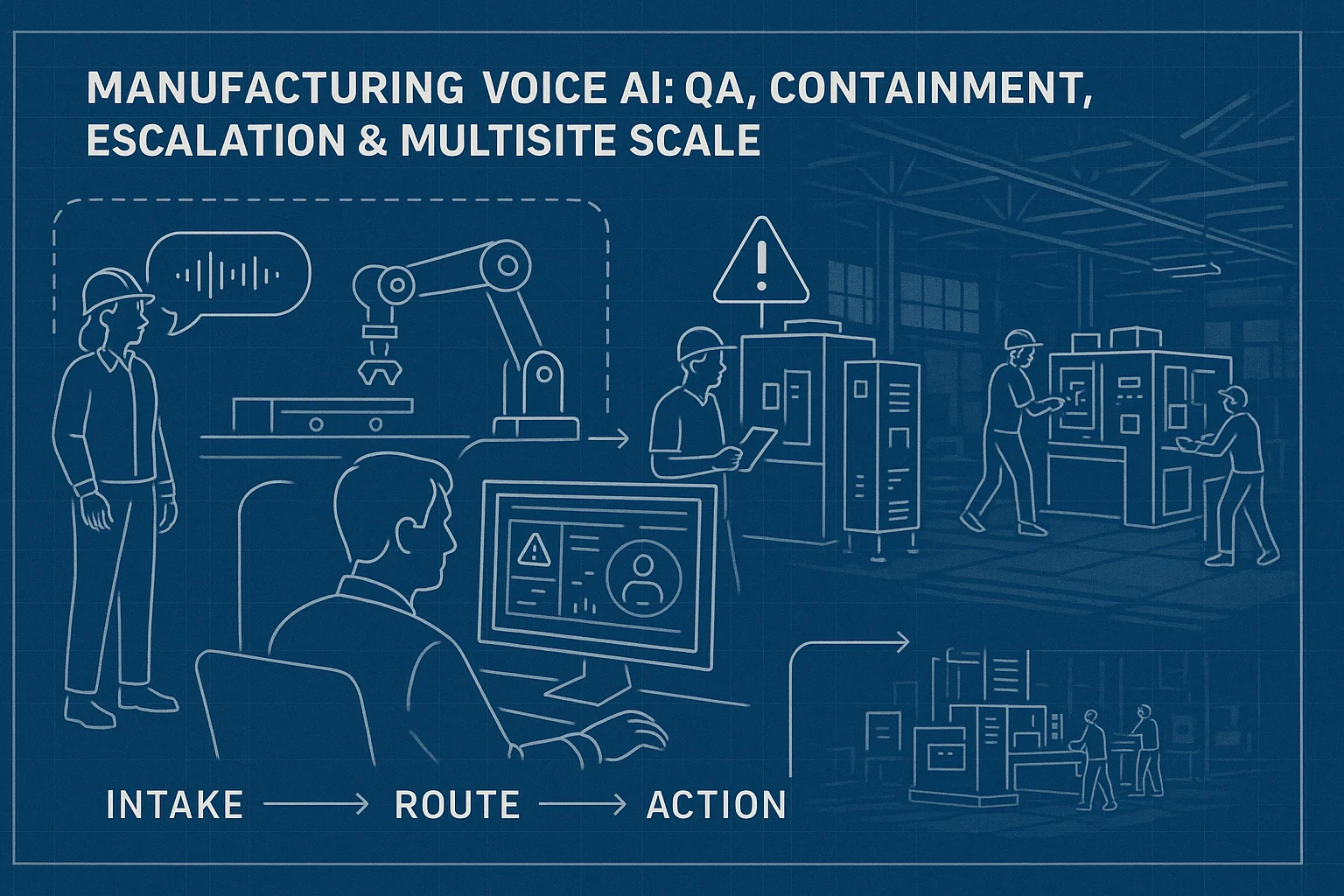
Use a predictable message path: Caller → Voice AI (ASR/NLU/Dialogue) → intent and product validation → ERP/CRM/warranty/service API → create/update case, place order, or specialist handoff. Each automated action must create an auditable transaction in the business system and surface a confidence score and the evidence bundle for escalations.
- Record structured fields (model, serial, part number, purchase date) and attach raw audio or transcript when allowed.
- Require explicit validation steps for actions that touch finance, warranty, or safety.
- Ensure the orchestration layer writes outcomes back to ERP/CRM for reconciliation and downstream reporting.
2. QA: Design, Test, and Operationalize
Treat QA as a product discipline that spans test design, automated coverage, human review, and continual sampling tied to outcomes in service systems.
Design QA around business outcomes
Translate business rules into testable scenarios. For manufacturing, that means test cases for parts resolution, warranty eligibility gates, multilingual utterances, noisy-plant audio, and failure-code capture. Create acceptance criteria that reference downstream system state: e.g., 'Voice AI will correctly populate ERP case fields for 95% of model-and-serial capture tests in quiet and controlled noise profiles.' Avoid claiming guaranteed rates; use them as internal targets validated by sampling.
- Map every call outcome to a downstream reconciliation entry in ERP/CRM.
- Create edge-case tests: partial serials, factory floor noise, accents, disconnected callers.
- Include negative tests: mis-typed part numbers, out-of-warranty dates, and ambiguous fault descriptions.
Operational QA: sampling, annotations, and escalation audits
Operational QA is continuous. Use stratified sampling (by site, language, product line and call type) and retain a human annotation workflow to score intent, entity extraction (serial/part), routing correctness, and containment appropriateness. Tie QA metrics to business KPIs: recontact rate, escalation accuracy, mean time to resolution (MTTR), and cost-to-serve per ticket.
- Sample both contained calls (self-service) and escalated calls to detect false containment and missed escalations.
- Record and store annotation metadata: scorer, date, issue type, corrective action.
- Use QA results to prioritize model retraining, call-flow changes, or business-rule updates.
3. Containment Quality and Cost-to-Serve
Containment is valuable only when it avoids downstream work. Measure containment together with recontact and downstream correction costs to understand true cost-to-serve.
Designing safe containment
Define containment scope explicitly: what the system can resolve fully (e.g., order status), what it may provisionally resolve pending human review (e.g., non-critical warranty intake), and what it may never auto‑approve (e.g., warranty approvals, safety exemptions, engineering change orders). For provisional resolutions, require a human sign‑off and attach the evidence bundle collected by Voice AI.
- Label call outcomes with containment type: resolved, provisional (requires review), handed-off.
- Never allow automated approval of warranty coverage, safety clearances, or engineering decisions without explicit human acceptance and audit trail.
- Track whether contained calls result in rework or returns within a defined window (e.g., 30 days).
Measuring cost-to-serve
Calculate total cost-to-serve per contact: telephony and platform costs, agent handling time for escalations, parts picking and shipping, and any rework. Report containment rate alongside 'good containment'—the percentage of contained calls that required no additional human work and no downstream correction. Use these metrics to set QA thresholds and to decide whether to expand automated scopes.
- Report containment rate, recontact rate, escalation precision, and average handling cost together.
- Use cohort analysis by product line, site, and language to find where containment is profitable.
- Adjust call flows where containment yields high recontact or warranty reversals.
4. Escalation Quality: Routing, Metadata and SLAs
When Voice AI escalates, the handoff must be measurable, auditable, and actionable. Poor handoffs negate automated gains and frustrate technicians and dealers.
Validated escalation triggers and routing
Escalation triggers should be explicit rules (confidence threshold, certain keywords, warranty flags, safety indicators) and routed by skill, parts ownership, or dealer territory. Include contextual metadata: extracted entities, confidence scores, recording/transcript links, and recommended next action. Peak Demand implementations typically custom-build call flows to route by SKU, warranty state, and distributor/dealer ownership so the specialist receives the full context.
- Use skill-based routing that includes part ownership and warranty status.
- Attach evidence bundle (transcript, audio snippet, captured photos) to the ticket at handoff.
- Log why escalation occurred (rule id, confidence score) for downstream QA.
Escalation SLAs, audit trails and specialist workflows
Define SLAs for initial acknowledgement and resolution by the receiving human team. Maintain audit trails that record who accepted the handoff, changes made in ERP/CRM, and any overrides to Voice AI recommendations. This is essential for warranty disputes and for continuous improvement.
- Require human acceptance for warranty approvals and safety or engineering changes.
- Monitor time-to-accept and time-to-resolution as escalation KPIs.
- Keep a changelog that links the original Voice AI outcome to final case disposition.
5. Multisite and Multilingual Scale
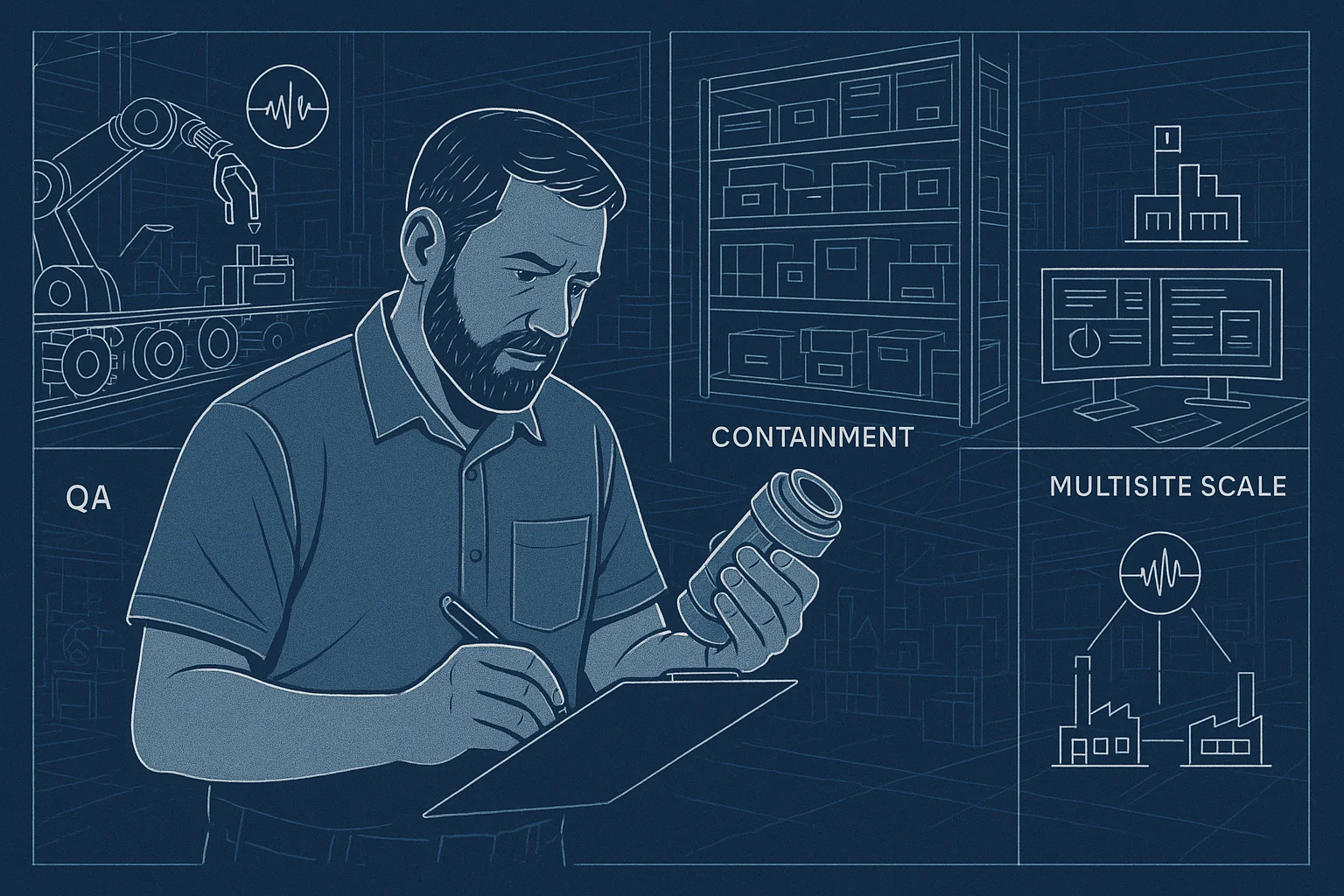
Scaling across sites and languages multiplies complexity. Standardize where possible; localize where necessary.
Site templating and per-site configuration
Create a canonical call-flow template and deploy per-site configurations that include site-specific parts catalogs, warranty rules, working hours, on-call rosters, and ERP endpoints. Centralized templates accelerate rollouts while per-site overrides handle local variations in part numbers, dealer networks, or labor rules. Ensure telemetry is consistent across sites to compare KPIs.
- Maintain a central configuration registry with per-site override layers.
- Map site-specific part catalogs and warranty rules to a normalized schema for global reporting.
- Ensure a common telemetry schema for containment, escalation, and QA metrics.
Multilingual operations and accuracy controls
Treat language support as a first-class operational item. Use locale-aware NLU models, confirm SKU and serial normalization across languages, and include language-specific QA sampling. For critical outcomes (warranty, safety), require human verification regardless of model confidence for lower-resource languages.
- Normalize key fields (part numbers, dates, serials) so they are language-agnostic in back-end systems.
- Set stricter containment thresholds for lower-confidence languages or dialects.
- Plan for human-in-the-loop review capacity in each supported language.
6. Continuous Optimization, Observability and Governance
Operational gains emerge from closed-loop measurement. Observability into transcript-level errors, business-system reconciliation, and human corrections drives model updates and call-flow changes.
Closed-loop analytics and model lifecycle
Ingest telemetry from Voice AI (intent/confidence/entities), ERP/CRM outcomes, QA annotations, and recontact data into a common analytics layer. Use that data to prioritize retraining, update dialogue rules, or alter containment thresholds. Maintain versioning for call flows and models so you can correlate changes with KPI shifts.
- Combine voice-platform telemetry and business-system outcomes in one dataset for root-cause analysis.
- Version call flows and ML models; annotate releases with expected KPI changes.
- Use A/B and canary rollouts for major changes to limit risk.
Governance, security and OT/IT boundaries
For manufacturers, clearly separate Voice AI from OT control systems. Voice AI should never issue direct commands to machinery. Apply network segmentation, least-privilege APIs, and logging consistent with industrial cybersecurity guidance. Confirm data residency, retention, and subprocessors during procurement and include breach and notification duties in contracts. Organizations should validate obligations with qualified legal and compliance professionals.
- Network-segment the orchestration layer from OT networks; never permit voice systems to issue actuation commands.
- Document subprocessors, hosting region, backup region, remote-access paths, retention periods, and breach notification duties.
- Apply role-based access control and key management for integrations with ERP/CRM.
Related Peak Demand resources
Industry and AI sources reviewed
- Cybersecurity Resources for ManufacturersNIST Manufacturing Extension Partnership
- Guide to Operational Technology SecurityNational Institute of Standards and Technology (NIST)
- Cross-Sector Cybersecurity Performance GoalsCybersecurity and Infrastructure Security Agency (CISA)
Manufacturing cybersecurity, operational-technology, product, warranty, records, and workplace obligations vary by jurisdiction and operating environment. This article is operational guidance, not legal advice; organizations should confirm applicable requirements with qualified professionals.
Frequently asked questions
Strong starting points include parts and order-status requests, distributor or dealer support, warranty and service intake, appointment scheduling, case creation, basic product information, and routing to technical specialists. Keep engineering judgment, safety decisions, and operational-technology control outside the conversational layer.
Official reference: Cybersecurity Resources for Manufacturers
The workflow should collect structured identifiers such as model, serial number, part number, customer account, asset location, and symptoms, then validate them against ERP, CRM, catalogue, warranty, or service systems. The agent should escalate rather than invent a match when confidence is low.
Official reference: Cybersecurity Resources for Manufacturers
Not by default. Customer-service automation should normally use controlled business-system integrations and tightly governed adapters. Any connection near operational technology requires explicit security architecture, least privilege, monitoring, and separation from safety-critical control functions.
Official reference: Guide to Operational Technology Security
Require workflow mapping, integration ownership, test evidence, fallback behavior, auditability, security boundaries, change control, monitoring, human escalation, and a plan for maintaining product, parts, warranty, and service knowledge after launch.
Official reference: Cybersecurity Resources for Manufacturers
Connect Voice AI to real manufacturing service operations
Peak Demand helps manufacturers automate parts, order, warranty, dealer, distributor, and service requests through controlled integrations, validation, escalation, and reporting.
Schedule a discovery call