
Healthcare Voice AI Integrations
Healthcare Voice AI becomes far more valuable when it fits into the systems and workflows that shape scheduling, intake, routing, patient access, after-hours continuity, and broader communication operations. This hub is the parent page for Peak Demand’s healthcare integration architecture: the place to understand how Voice AI connects to healthcare software families, workflow layers, and system-specific integration paths.
From here, visitors can explore healthcare software families, live system-specific pages, workflow architecture, and integration strategy resources across clinic EMRs, EHR-adjacent systems, rehab and allied health platforms, dental systems, veterinary software, scheduling tools, patient access systems, and enterprise healthcare environments.
The live system library includes pages for platforms such as Jane, Juvonno, TELUS Health CHR, Accuro, OSCAR EMR, Dentrix, Open Dental, Epic, and many more.

Architecture Role
Parent hub for healthcare integrations
System Coverage
98 healthcare system pages
Software Families
6 healthcare integration families
Workflow Focus
Scheduling, intake, routing, access
Healthcare integrations should be evaluated through workflow continuity
One of the biggest mistakes in healthcare integration conversations is reducing the discussion to a list of software names. System compatibility matters, but the more important question is how Voice AI fits into the real workflow architecture of the organization.
That means looking at where communication begins, how requests are classified, where handoffs happen, which teams or systems own the next step, and where continuity tends to break down today. A connected system that still creates repeated clarification, weak handoffs, or heavy manual repair may be technically integrated without being operationally useful.
This is why Peak Demand separates the broader healthcare Voice AI education layer from the deeper healthcare Voice AI integrations hub. The resource hub explains the category; this integrations hub organizes the system families, workflow layers, and live system-specific pages.
Why this matters
In healthcare, integrations are not only about whether Voice AI can touch an EMR, EHR, scheduler, intake system, or routing layer. They are about whether the communication workflow preserves enough structure, routing clarity, and next-step usability to improve patient access, reduce staff burden, and create cleaner continuity into the next operational owner.
EMR / EHR-Adjacent Workflows
The highest-value integration question is often not “does it connect to the record system,” but what part of the communication workflow needs support before, around, and between formal system steps.
- Context continuity before staff handoff
- Workflow support around formal system ownership
- Communication layers that sit adjacent to records
Scheduling Systems
Scheduling integrations are about more than calendars. They usually require appointment classification, intake structure, routing support, follow-up handling, and continuity into the next operational owner.
- Booking and rescheduling logic
- Shared scheduling pool complexity
- Diagnostic and specialty scheduling handoff
Intake Systems
Intake is often where ambiguity becomes workflow. Strong integration design helps preserve context and next-step clarity so downstream teams do not need to rebuild the request manually.
- Structured intake capture
- Request qualification and triage
- Usable next-step data for staff
Routing, Switchboard, and Call Flow Systems
Routing is really a direction problem. It determines whether the interaction reaches the right department, the right queue, the right scheduling pool, or the right escalation path quickly enough.
- Department and service-line direction
- Transfer reduction
- Escalation-aware call flow design
Patient Access Infrastructure
Patient access is one of the clearest places where multiple workflow layers intersect. Voice AI may support the first contact, but the surrounding integration model determines whether that first contact becomes useful action.
- Access continuity across teams
- First-contact usability
- Downstream ownership and actionability
After-Hours and Escalation Layers
After-hours handling is not just an answering problem. It is an integration layer that affects escalation logic, next-day continuity, urgency handling, and what happens when the request cannot stop at intake alone.
- Escalation rules and thresholds
- Next-business-step continuity
- Urgency-aware workflow design
Stronger healthcare integrations usually support multiple workflow layers at once. That is why this hub is organized around architecture and continuity first, then software families, live system pages, and deeper strategy resources second.
Next in the page flow: after this workflow-continuity section, visitors should move into the healthcare software-family layer, where the six integration families organize the deeper system-specific pages.
Browse Healthcare Software Families
Rank Higher Fast: Core HVAC Service Pages and Local SEO Keywords You’re Missing - The Ultimate Guide
Introduction: Why This HVAC SEO Guide Will Get You More Calls
If you run an HVAC company and want the phone to ring without cranking ad spend, you’re in the right place. This guide shows you exactly how to use HVAC SEO and local SEO to rank in Google/Maps, capture organic leads, and turn searchers into booked jobs.
Who this is for
Owners & general managers who want steady service calls and more high-value installs.
Ops managers & office admins who need a simple plan for pages, reviews, and Google Business Profile.
Solo contractors & small teams who can’t afford to miss calls—or waste time on guesswork.
What you’ll get
Exact service pages to build (the “money pages” that drive calls): furnace/AC repair & install, heat pumps, ductless, boilers, IAQ, maintenance, commercial.
Local SEO playbook for city and suburb pages that actually rank (one service + one location per page).
Keyword lists that convert: emergency, problem-based, brand/part, commercial, and seasonal terms (e.g., “no heat [city]”, “Mitsubishi mini split installer [city]”).
On-page templates: recommended H1s, URL slugs, first-paragraph copy, FAQs, and schema to win Google and Map Pack.
Google Business Profile checklist: categories, services, photos, reviews, and booking links that push you into the top 3.
Quick wins you can deploy in a week: fix titles/H1s, add FAQs, tighten CTAs, publish city pages, and spark a review surge.
By the end, you’ll have a copy-ready plan to build the right pages, target the right keywords, and rank higher fast—so more local homeowners and property managers call you first.
The Must-Have HVAC Service Pages (Money Pages)

Below are the core pages that drive calls and revenue. For each one, use one clear service focus, city modifiers where relevant (e.g., “[City], [Province]”), and a strong CTA above the fold.
Furnace Repair (Emergency Heating)
H1: Furnace Repair & 24/7 Emergency Heating in [City]
URL slug: furnace-repair-[city]
Primary keywords: furnace repair [city], emergency furnace repair, no heat [city]
Supporting keywords: same-day heating repair, furnace service near me, after-hours HVAC
First-paragraph copy:
“No heat or strange furnace noises? We provide same-day furnace repair in [City]. Our licensed techs diagnose fast and fix all makes and models—day or night.”
CTA copy: Book Emergency Furnace Repair (24/7)
Internal links: Maintenance Plans, Boiler Repair (if relevant), Heating Tune-Up
Furnace Installation & Replacement
H1: Furnace Installation & High-Efficiency Replacements in [City]
URL slug: furnace-installation-replacement-[city]
Primary keywords: furnace installation [city], furnace replacement [city], high-efficiency furnace
Supporting keywords: financing available, furnace quote [city], energy-efficient heating
First-paragraph copy:
“Upgrade to a high-efficiency furnace that lowers bills and boosts comfort in [City]. We size systems correctly, handle permits, and offer financing.”
CTA copy: Get a Free Furnace Quote
Internal links: Rebates/Financing, Maintenance Plans, IAQ (filters/HRV)
AC Repair (Same-Day Cooling)
H1: AC Repair & Same-Day Air Conditioning Service in [City]
URL slug: ac-repair-[city]
Primary keywords: AC repair near me, air conditioner repair [city], AC not cooling
Supporting keywords: same-day AC service, central air repair, emergency AC repair
First-paragraph copy:
“AC not cooling? We provide fast air conditioner repairs in [City] with stocked vans and transparent pricing—so you’re back to comfortable quickly.”
CTA copy: Schedule AC Repair Today
Internal links: AC Installation, Ductless Mini-Split, Maintenance Plans
AC Installation & Central Air Upgrades
H1: Air Conditioning Installation & Central Air Upgrades in [City]
URL slug: air-conditioning-installation-[city]
Primary keywords: air conditioning installation [city], central air install [city]
Supporting keywords: SEER2 efficiency, AC replacement, cooling system quote
First-paragraph copy:
“Stay cool with a properly sized central air system. We install high-efficiency ACs in [City] with clean workmanship, warranties, and financing.”
CTA copy: Request an AC Install Quote
Internal links: Ductwork Services, Smart Thermostats, IAQ
Heat Pump Installation (Cold Climate)
H1: Cold-Climate Heat Pump Installation in [City]
URL slug: heat-pump-installation-[city]
Primary keywords: heat pump installation [city], cold climate heat pump [province], heat pump rebates
Supporting keywords: energy-efficient heating and cooling, heat pump quote, electrification
First-paragraph copy:
“Cut energy costs with a cold-climate heat pump designed for [Province] winters. We manage sizing, rebates, and clean installation.”
CTA copy: Check Your Heat Pump Rebate & Quote
Internal links: Rebates/Financing Hub, Ductless Mini-Split, IAQ
Ductless Mini-Split Systems
H1: Ductless Mini-Split Installation & Service in [City]
URL slug: ductless-mini-split-[city]
Primary keywords: ductless installation [city], mini split heat pump [city]
Supporting keywords: room-by-room comfort, heritage homes, condo cooling
First-paragraph copy:
“Add quiet, efficient heating and cooling to any room—no ducts needed. We install and service leading ductless systems in [City].”
CTA copy: Get a Ductless Quote
Internal links: Heat Pump Install, Electrical (if in-house), IAQ
Boiler Repair & Hydronic Heating
H1: Boiler Repair, Replacement & Hydronic Heating in [City]
URL slug: boiler-repair-installation-[city]
Primary keywords: boiler repair [city], boiler replacement [city], hydronic heating
Supporting keywords: combi boilers, radiant floor heating, annual boiler service
First-paragraph copy:
“From no-heat emergencies to high-efficiency boiler upgrades, our hydronic specialists keep your home comfortable and safe.”
CTA copy: Book Boiler Service
Internal links: Maintenance Plans, Radiant Heating, Water Quality/Filtration
Indoor Air Quality (IAQ): HRV/ERV, Filtration, Purifiers
H1: Indoor Air Quality: HRV/ERV, Filtration & Air Purifiers in [City]
URL slug: indoor-air-quality-hrv-erv-filtration-[city]
Primary keywords: HRV installation [city], ERV [city], air purifier [city], MERV filters
Supporting keywords: CO₂/PM2.5, fresh air ventilation, whole-home air cleaner
First-paragraph copy:
“Breathe better with balanced ventilation and whole-home filtration. We design IAQ solutions for allergies, odors, and healthier air.”
CTA copy: Get an IAQ Assessment
Internal links: Maintenance Plans, Duct Sealing, Smart Thermostats
HVAC Maintenance Plans
H1: HVAC Maintenance Plans & Seasonal Tune-Ups in [City]
URL slug: hvac-maintenance-plans-[city]
Primary keywords: HVAC maintenance plan [city], furnace tune-up [city], AC tune-up [city]
Supporting keywords: priority service, seasonal inspections, extend equipment life
First-paragraph copy:
“Prevent breakdowns and lower bills with a scheduled maintenance plan. Members get priority service, discounts, and seasonal tune-ups.”
CTA copy: Choose Your Plan (Good/Better/Best)
Internal links: Furnace/AC Repair, Heat Pump, IAQ
Commercial HVAC Services
H1: Commercial HVAC: RTUs, Maintenance Contracts & Controls in [City]
URL slug: commercial-hvac-services-[city]
Primary keywords: commercial HVAC contractor [city], rooftop unit repair [city], HVAC maintenance contract
Supporting keywords: BMS/controls, preventative maintenance, 24/7 service
First-paragraph copy:
“Reliable building comfort with proactive maintenance and rapid response. We service RTUs, boilers, and controls for offices, retail, and light industrial.”
CTA copy: Request a Commercial Site Assessment
Internal links: Maintenance Contracts, Controls/Automation, IAQ for Commercial
Page Elements That Increase Rankings and Calls (add to each page)
Proof: real photos (team, trucks, jobs), review snippets, badges (licenses, insurer, manufacturer)
Conversion UX: click-to-call button, short booking form, sticky “Book Now” bar, after-hours messaging
FAQ block: 3–5 “People Also Ask”-style questions (repair costs, timelines, brands, warranties)
Schema:
Service,LocalBusiness, andFAQPagewhere applicableLocation cues: service-area map, neighborhoods served, nearby landmarks
Internal links: route to relevant services, maintenance plans, rebates/financing, and city pages
Build these pages first, then clone the winning template for each priority city/suburb (one service + one location per page) to scale organic lead flow.
HVAC Local SEO 101: City & Suburb Pages That Actually Rank

Rule #1: One service + one location per page.
Don’t bundle “heating + cooling” or six cities on one URL. If you want to rank for “furnace repair in Oakville,” build a page just for that.
The winning page template (copy-ready)
H1: Service + City (e.g., “Furnace Repair in Oakville — Same-Day Heating Service”)
Intro (60–100 words): Speak to local pains and speed (“No heat in Oakville? Our licensed techs fix all makes, same day.”)
Service area map: Embedded Google Map centered on your address or service area; list nearby neighborhoods and landmarks.
Neighborhoods served: Bullet list (e.g., Glen Abbey, Kerr Village, Bronte).
Proof block: 2–3 local testimonials + star rating image; add one job photo from that city.
Why choose us (localized): Response time, parts on truck, warranty; mention city conditions (older furnaces near the lake, common ductless installs in condos).
Pricing/expectations: Typical diagnostic fee, common fixes, financing line if relevant.
FAQ (3–5 Qs): “Do you service [brand]?” “Can you come tonight?” “What’s the average repair cost?”
CTA: Big, persistent “Book Furnace Repair in Oakville” button; click-to-call and short form above the fold.
Schema:
Service,LocalBusiness,FAQPage.
Keyword patterns that pull calls
Emergency/intent: “furnace repair [city]”, “no heat [city]”, “24/7 furnace repair [city]”
Install/upgrade: “heat pump installation [city]”, “central air install [city]”
Ductless: “ductless mini split installation [city]”, “mini split heat pump [city]”
Commercial: “commercial HVAC contractor [city]”, “rooftop unit repair [city]”
Neighborhood variants: “[service] [neighborhood]”, “[service] near [landmark]”
Example H1s and slugs
H1: “AC Repair in Mississauga — Same-Day Air Conditioning Service”
Slug:ac-repair-mississaugaH1: “Ductless Mini-Split Installation in North York”
Slug:ductless-mini-split-north-yorkH1: “Heat Pump Installation in Calgary (Cold-Climate Specialists)”
Slug:heat-pump-installation-calgary
Internal linking that lifts rankings (and conversions)
From blog posts (“AC not cooling? 7 fixes…”) → link to AC Repair [City] page with keyword-rich anchor.
From city pages → link to core service pages (e.g., Furnace Repair → Maintenance Plans, Heat Pump Install → Rebates).
From service pages → link out to top three city pages you want to rank first.
Add a breadcrumbs trail (Home → Services → Furnace Repair → Furnace Repair Oakville).
Google Business Profile alignment
Make sure the service area list in GBP includes each city page you publish.
Reuse the same city photos (team/truck at a recognizable spot) on the page and on GBP.
Post a short GBP Update when the page goes live (“Now serving furnace repair in Oakville—same day.”) and link to it.
Content tips that move the needle
Mention local cues: neighborhoods, road names, building types, utility rebates.
Include at least one unique photo per city page. Stock photos tank trust.
Keep first 100 words laser-focused on Service + City + Problem + Solution.
Don’t copy/paste entire pages—swap in city-specific FAQs, testimonials, and examples.
Quick build checklist
Service + City H1 and matching slug
80–120 word local intro with primary keyword
Map embed + neighborhoods list
2 local reviews + 1 project photo
Clear CTA (button + click-to-call)
FAQ + Service/LocalBusiness/FAQ schema
Internal links in and out (blog ↔ service ↔ city)
Follow this pattern for your top 5–8 services across your top suburbs/cities. It’s repeatable, scalable, and it’s how you earn Map Pack visibility and organic calls fast.
HVAC Google Business Profile: Map Pack Wins

Showing up in the top 3 on Google Maps (“Map Pack”) is often the fastest path to more calls. Here’s how to tune your Google Business Profile (GBP) so it ranks and converts.
Set up the foundation (one-time, then review quarterly)
Primary category: Pick the one that best matches your main money-maker. Common picks:
HVAC contractor (good all-around)
Furnace repair service (winter-heavy markets)
Air conditioning repair service (summer-heavy markets)
Heating contractor
Secondary categories: Add the rest (AC repair, HVAC installation, Boiler repair, Air duct cleaning, etc.). Don’t overstuff—4–6 is plenty.
Services: List specific services using the phrases customers search:
Furnace repair, Furnace installation, Emergency heating
AC repair, Air conditioning installation
Heat pump installation (cold climate), Ductless mini-split install
Boiler repair/replace, Hydronic heating
Indoor air quality: HRV/ERV, filtration, purifiers
Add short, plain-English descriptions and (optional) “From $$” pricing.
Hours: Set accurate open hours; add More hours for “Emergency service” if you take after-hours calls. Update holiday hours early.
Service areas (SABs): If you go to customers (no public storefront), hide your address and list cities/suburbs you actually serve. 10–20 targeted areas beat a giant radius.
Booking link: Use the Appointment links field to your booking page (calendar or short form). Attach tracking (e.g., utm_source=google&utm_medium=organic&utm_campaign=gbp_booking) so you can measure conversions.
Phone numbers: If you use a call-tracking number, set it as primary and your main business line as additional to keep NAP consistency.
Photos that convert (and how to post them)
Prioritize real photos over stock. Aim for 2–3 fresh uploads per month:
Team & trucks in recognizable local spots (builds trust + “local” relevance).
Job site before/after (clean installs, tidy mechanical rooms, ductless on brick).
Close-ups of brand-name equipment you actually service/install.
Interior/exterior of your shop (if applicable).
Tips: Shoot horizontal, well-lit, clutter-free. Add short captions (“Heat pump install in [Neighbourhood]”). Post via the GBP app when you’re on-site to reinforce locality.
Reviews: when to ask, how to ask, and what to reply
When to ask: At the “moment of delight”—heat is back on, AC is cooling, install looks great—before you leave.
How to ask:
Techs trigger an SMS with your review link from the field app.
Leave a small card/QR on the furnace or panel.
Script (natural, not pushy): “Reviews help local homeowners find us. If today felt 5-star, could you share a few words about the service in [City]?”
What to ask for: Suggest they mention the service and city (“furnace repair in [City]”) and the tech’s name—this naturally adds keywords.
Reply templates (steal these):
Positive: “Thanks, [Name]! Glad we could get your [service] fixed fast in [City]. We’ll be here if you need us before winter.”
Mixed: “Appreciate the feedback, [Name]. I’m having our service manager call today to make this right.”
Negative: “Sorry we missed the mark, [Name]. Please DM/call [direct line]; we’ll prioritize a fix and update here once resolved.”
Aim for steady velocity: 5–10 new reviews/month per location.
Posts & Q&A: capture seasonal searches
Weekly Posts (150–300 characters + photo + CTA):
Winter (No heat): “No heat in [City]? Same-day furnace repair. Book now.”
Summer (AC not cooling): “AC blowing warm air? We service all makes.”
Heat pumps: “Cold-climate heat pump installs with [Province] rebates. Free quote.”
Tune-ups: “Fall furnace tune-up—prevent surprise breakdowns.”
Use buttons like Call now, Book, or Learn more (to a relevant page). Posts expire; refresh weekly.
Q&A (seed your own): Add and answer the top questions customers ask on the phone:
“Do you offer 24/7 emergency furnace repair in [City]?”
“Can you install a ductless mini split in a condo?”
“Do you handle rebates for heat pumps in [Province]?”
Keep answers short, clear, and service + city specific.
Extra signals that help you win the Map Pack
Consistency: Make sure your name, phone, and service areas match your website and major directories.
Products (optional): Showcase “packages” (e.g., “Heat Pump Install—Cold Climate”) with photos and a link.
Messages & Call history: Turn them on in GBP; set notifications so no inquiry sits unanswered.
UTMs everywhere: Add tracking to your website link and booking link to measure calls/forms from GBP.
Website alignment: Each service listed in GBP should point to a matching service page on your site (not just the homepage).
Do this well and you’ll see more impressions, more “Calls from GBP,” and—most importantly—more booked jobs from homeowners and property managers in your service area.
HVAC Keyword Clusters You’re Probably Missing

Targeting “money intent” keywords turns searches into calls. Build or tune pages around these clusters and use them in titles, H1s, first 100 words, FAQs, and your Google Business Profile (GBP) services and Posts.
Emergency intent (ready-to-book now)
Examples: 24/7 furnace repair [city], same-day AC repair [city], no heat [city], leaking AC [city]
Where to use:
Standalone emergency pages: “24/7 Furnace Repair in [City]—No Heat? Call Now.”
City pages: add an “Emergency Service” subsection and FAQ.
GBP Posts every week in peak season (“No heat in [City]? Same-day help.”).
Quick win:Add “Open late” or “Emergency service” hours in GBP and a sticky “Call Now” button site-wide.
Problem intent (what the homeowner actually types)
Examples: furnace not blowing hot air, AC not cooling, strange furnace noise, frozen AC line
Where to use:
Blog troubleshooting posts that link to the matching repair page.
FAQ blocks on repair pages (structured with FAQ schema).
Short GBP Q&A answers using the problem phrase + city.
Quick win:Publish two guides: “AC Not Cooling in [City]: 5 Quick Checks (and When to Call)” and “Furnace Not Blowing Hot Air in [City].” Link to your repair page.
Brand/part intent (buyers with wallets out)
Examples: Mitsubishi mini split installer [city], Daikin heat pump installer [city], blower motor replacement [city], heat exchanger crack repair
Where to use:
Mini brand hubs: one page per top brand you actually sell/service.
Parts/repair subpages (blower motor, capacitor, control board) under Furnace/AC Repair.
Project photos with brand names in captions.
Quick win:Add a “Mitsubishi Mini-Split Installation in [City]” page with photos, models, warranties, and a “Book a Quote” CTA.
Commercial intent (B2B, higher ticket)
Examples: rooftop unit repair [city], commercial HVAC contractor [city], HVAC maintenance contract [city], building controls [city]
Where to use:
Dedicated Commercial hub plus subpages (RTUs, maintenance contracts, controls/BMS, IAQ).
Case studies per vertical (retail plaza, office, light industrial).
LinkedIn/GBP Posts with site photos and outcomes (“RTU swap—Downtown [City]”).
Quick win:Publish “Commercial HVAC Maintenance Contracts in [City]—What’s Included & Pricing Ranges,” then link it from your Commercial hub and GBP.
Seasonal intent (own the peaks)
Examples: winter heating repair [city], furnace tune-up [city], summer AC repair [city], spring HVAC maintenance, fall furnace tune-up
Where to use:
Seasonal landing pages (reuse annually; just refresh dates/offers).
Blog posts that support the page (e.g., rebate updates, pre-season checklists).
GBP Posts tied to weather swings (“Cold snap coming—tune-ups available this week”).
Quick win:Launch two evergreen pages now: “Fall Furnace Tune-Up in [City]” and “Spring AC Tune-Up in [City],” each with a simple booking form.
How to deploy without cannibalizing rankings
One intent per page (don’t cram emergency + install + brand into a single URL).
Cross-link smartly: blog (problem intent) → repair page → maintenance plan.
Mirror GBP services to your live pages (each GBP service links to its matching URL).
Track calls by page type with unique numbers; promote winners across more cities.
Copy snippets you can paste
Title tag: No Heat in [City]? 24/7 Furnace Repair | Same-Day Service
H1: AC Repair in [City]—Not Cooling? We Can Be There Today
First paragraph: “AC not cooling in [City]? Our licensed techs diagnose all brands, same-day. Transparent pricing and stocked vans mean faster fixes—book now.”
CTA: Book Same-Day Service | Request a Heat Pump Quote | Get a Commercial Site Assessment
HVAC On-Page SEO That Moves the Needle

Strong pages win twice: they rank and they convert. Use this pattern on every money page (repair/install/heat pump/ductless) and each city page.
Title tag, H1, and first 100 words (the “ranking trio)
Title tag (≤60 chars): Furnace Repair in [City] | Same-Day Heating Service
Meta description (≤155 chars): No heat in [City]? Licensed furnace repair. Same-day service, upfront pricing. Book now.
H1: Furnace Repair in [City] — Same-Day Heating Service
First 100 words: Hit service + city + problem + solution immediately. Example: “No heat in [City]? Our licensed techs provide same-day furnace repair on all brands. We diagnose fast, carry common parts on the truck, and back repairs with a 1-year labor warranty. Call or book online.”
Schema (Service, LocalBusiness, FAQ) without code
Add Service and LocalBusiness schema to each service page with your real name, phone, URL, address/area served, and the specific service name (e.g., “Furnace Repair in [City]”).
Add FAQ schema to 3–5 real questions you answer on the page (e.g., “Do you offer same-day service in [City]?”).
Make sure the service listed in schema matches the page topic and your Google Business Profile services.
Service checklists, pricing ranges, financing, rebates
Checklist block (3–6 bullets): symptoms you fix, what’s included, typical timelines.
Transparent ranges: “Most furnace repairs in [City] fall between $180–$650; we always confirm pricing before work begins.”
Financing line: “Ask about 0% for 6 months on replacements.”
Rebate callout (Canada/province): “Cold-climate heat pump rebates up to $X,000—paperwork handled.”
Trust blocks (proof sells)
Licenses and insurance badges, manufacturer badges, trade association logos.
Review snippet: “4.8★ (327 Google reviews) — ‘Fixed our no-heat in 2 hours.’ — J. Singh, [Neighbourhood].”
Guarantees: “1-year labor warranty,” “No-surprise pricing,” “Clean home promise.”
Real photos: team, trucks, local job sites with city/neighbourhood captions.
Conversion UX (make calling/booking effortless)
Prominent click-to-call button, especially on mobile.
Sticky CTA bar that follows scroll: “Book Same-Day Service.”
Short booking form (max 5 fields): Name, Phone, Email, Address/Neighbourhood, Problem dropdown.
Urgency microcopy: “Call before 3pm for same-day service in [City].”
After-hours swap: “Request 8:00 AM Call-Back” with instant confirmation text.
Placement blueprint (repeat on every page)
Hero: H1 + 2-line value prop + click-to-call + short form + trust badges
Problem/Solution intro: first 100 words with primary keyword
Checklist + pricing range + financing/rebate strip
Local proof: neighborhoods served, 2–3 local reviews, 1 job photo
FAQ (3–5 Qs) that mirror real calls you get
Final CTA: Book now + phone + hours + after-hours message
Quick copy you can paste
CTA button: Book Same-Day Furnace Repair
Form header: Tell us what’s wrong—we’ll confirm your time
After-hours banner: We’re closed now, but add your number and we’ll call at 8:00 AM.
Pricing line: Most repairs in [City] fall between $180–$650; we confirm pricing before work begins.
Guarantee line: 1-year labor warranty and no-surprise pricing on all repairs.
Quality control checklist (5-minute sweep before publishing)
Title tag and H1 use the exact service + city phrase
Primary keyword appears in first 100 words
One clear CTA above the fold (phone + form)
At least one unique local photo and two local reviews
Internal links to related services, maintenance plans, rebates, and your top city pages
Service, LocalBusiness, and FAQ schema added (no code errors)
Page speed passes Core Web Vitals on mobile (fast load, compressed images)
Structure for Google, Maps, and ChatGPT Discovery for HVAC Companies

Design your site so search engines (and AI assistants) instantly understand what you do, where you do it, and how to book.
Build clear page silos
Heating: Furnace Repair, Furnace Installation, Boiler Repair, Heat Pump Installation
Cooling: AC Repair, AC Installation, Ductless Mini-Split
IAQ: HRV/ERV, Filtration, Purifiers, UV, Humidity Control
Commercial: RTUs, Maintenance Contracts, Controls/BMS, IAQ for Buildings
Locations: One service + one city per page (e.g., “Furnace Repair in [City]”)
Tips:Keep URL names consistent (service + city).
Mirror silos in your nav and breadcrumbs so bots see the structure.
Each silo has a hub page that links to its child pages (e.g., Heating → Furnace Repair, Boiler Repair, Heat Pump).
Use FAQs that match “People Also Ask”
Add 3–5 short Q&As on every service and city page using the exact phrases people type:
“Do you offer 24/7 furnace repair in [City]?”
“How much does AC repair cost in [City]?”
“Can a heat pump work in [Province] winters?”
“Do you install Mitsubishi mini-splits in condos?”
Best practices:Put concise, helpful answers right under each question.
Aim for one pricing range, one timeline, one booking next step.
Include at least one local detail in each answer (neighborhoods, weather, rebates).
Map your internal links (blog → service → city → booking)
Blog to Service: Problem posts link to the matching repair page
Example anchors: “AC not cooling checklist” → “AC Repair in [City]”Service to City: From the general service page, link to top 3 city pages for that service
City to Booking: Keep a visible “Book Now” and click-to-call on every city page
Cross-support: Heat Pump → Rebates page; Ductless → Condo/Heritage Homes page; Repair → Maintenance Plans
Footer/nav: Add persistent links to the core money pages and top cities
Answer local, seasonal, and brand questions in your content
Local (where you work)
Mention neighborhoods, landmarks, and typical home types.
Add one local project photo and a review from that city.
Seasonal (when demand spikes)
Winter: “No heat in [City], same-day furnace repair,” “Furnace tune-up”
Summer: “AC not cooling in [City], emergency repair,” “AC install quote”
Shoulder months: “Spring AC tune-up,” “Fall furnace tune-up”
Brand/part (buyers with intent)
Create short brand pages you actually support (Mitsubishi, Daikin, Bosch, Lennox).
Add part/problem subpages under repair (blower motor replacement, cracked heat exchanger, capacitor failure).
Use real install photos and list model families you carry.
Extra signals that help Google, Maps, and ChatGPT
Consistent NAP across site, Google Business Profile, and directories
Service pages that match your GBP “Services” list and link directly from GBP
Real photos with descriptive alt text (service + city), not stock
Fast mobile pages with clear CTAs (click-to-call, short form)
Trust blocks: licenses, insurance, warranties, review snippets on every money page
Quick checklist
One service + one city per page, with a matching URL and H1
FAQ block with PAA-style questions and concise answers
Internal links that lead people to a booking action in two clicks or less
Seasonal posts that feed your service and city pages
Brand/part pages for the equipment you actually sell and service
HVAC Photos, Videos, and Proof That Sell the Click

Treat visuals like sales assets—every image or clip should answer “Can I trust you to fix my problem in my city?”
Before/after galleries (by service and by city)
Create small galleries for each service (Furnace Repair, AC Install, Heat Pump, Ductless, Boiler) and duplicate per city page.
Per job, aim for 3–5 photos: “before,” “in-progress,” “after,” plus a wide shot of the space.
File names:
furnace-repair-before-[city].jpg,heat-pump-install-after-[city].jpg.Alt text (keep consistent): “Furnace repair in [City] — same-day heating service,” “Heat pump installation in [City] — cold-climate system.”
Add a one-line caption with the problem, fix, and outcome: “No heat—replaced failed igniter; heat restored in 90 minutes.”
Quality tips: good lighting, no clutter, horizontal orientation, show brand/model plate when relevant.
Publish the best 2–3 photos to your Google Business Profile with the same captions.
Short job recap videos (60–90 seconds)
Simple structure (no fancy edits needed):
Hook (5–8s): “No heat in [City]? Here’s today’s fix.”
Problem: what the homeowner reported.
Diagnosis & solution: what you found and did.
Outcome + proof: temp reading, airflow, happy customer note.
CTA: “Book same-day furnace repair in [City]—link below.”
Shoot formats: 16:9 for website/YouTube, 9:16 for Shorts/Reels. Add burned-in captions for silent viewers.
On-screen text: keep it big and centered—“No Heat Fixed • Same Day • [City]”.
Thumbnail: clear “After” image + short text (e.g., “Heat Restored • [City]”).
Reuse clips on the matching service page, the related city page, and your GBP as a Post.
Embed review snippets where they matter
Place 1–2 city-specific reviews near the top of each city page and 1–2 service-specific reviews on the matching service page.
Formatting that converts:
Star rating (4.8★), reviewer first name + neighborhood.
One-sentence outcome: “Restored heat in 2 hours—transparent pricing.”
Add a short “Why choose us” block under reviews: licenses, insurance, warranties, manufacturer badges.
Keep a rolling rotation: swap in fresh reviews monthly so pages don’t look stale.
Proof bundle placement (repeatable layout)
Above the fold: H1, 2-line promise, click-to-call, short form, badges + one review.
Mid-page: before/after mini-gallery + 60–90s recap video.
Near CTA: 2 more review snippets and a guarantee line (“No-surprise pricing • 1-year labor warranty”).
Compliance & trust notes
Get permission before showing customer faces/interiors; avoid house numbers/license plates.
For Canada, follow basic PIPEDA principles: consent for identifiable media, remove on request.
Don’t over-edit: real photos beat stock every time.
Performance tips (so pages stay fast)
Export images around 1200–1600px wide; compress to under ~250KB when possible.
Use consistent alt text patterns (service + city + outcome).
Aim for Core Web Vitals passing on mobile—your gallery shouldn’t slow the page.
Weekly content routine (easy to sustain)
3 jobs → 6–9 photos + 1 short recap video.
Post to: matching service page, matching city page, and GBP.
Add one seasonal GBP Post tied to the content (“No heat in [City]? Same-day repair—see today’s fix”).
HVAC Blog Topics That Feed Your Service Pages

Great blogs aren’t fluff—they answer the exact questions people Google and hand them off to the right service page. Use the topics below to rank long-tail searches, then link clearly to your repair, install, heat pump/IAQ, and maintenance pages.
Troubleshooting posts that link to repairs
Purpose: Capture “problem intent” (the phrases homeowners actually type) and send them to the repair page.
Sample titles:
AC Not Cooling in [City]? 7 Quick Checks Before You Call
Furnace Not Blowing Hot Air in [City]: What It Means and What to Do
Why Is My AC Line Frozen? Causes and Fast Fixes in [City]
Target keywords: “AC not cooling [city]”, “furnace not blowing hot air [city]”, “frozen AC line [city]”
Structure:60–100 word intro with service + city + problem
3–7 safe DIY checks
Clear “stop here and call” warnings
CTA: Book Same-Day [Service] in [City]
Internal link anchors:“Schedule AC repair in [City]” → AC Repair page
“Same-day furnace repair in [City]” → Furnace Repair page
URL slug: ac-not-cooling-[city], furnace-not-blowing-hot-air-[city]
“Repair vs replace” posts that link to installs
Purpose: Move high-intent readers toward installation quotes.
Sample titles:
AC Repair or Replace in [City]? Cost, Lifespan, and When to Upgrade
Furnace Repair vs Replacement in [City]: A Simple Decision Guide
Heat Pump Near End of Life? Repair vs Replace in [City]
Target keywords: “AC repair or replace [city]”, “furnace replacement cost [city]”
Structure:Lifespan + age thresholds
Cost ranges (minor/major repairs vs install)
Efficiency/rebate math (monthly bill impact)
CTA: Get a Free [System] Install Quote
Internal link anchors:“Request an AC installation quote” → AC Installation page
“High-efficiency furnace replacement in [City]” → Furnace Installation page
URL slug: ac-repair-vs-replace-[city], furnace-repair-vs-replace-[city]
Rebate guides per province/state that link to heat pumps/IAQ
Purpose: Earn links, rank for “rebate” searches, and drive installs.
Sample titles:
Heat Pump Rebates in [Province] for 2026: Amounts, Eligibility, How to Apply
IAQ & Ventilation Rebates in [Province]: HRV/ERV Incentives for Homes
Home Electrification in [Province]: Grants, Loans, and Tax Credits
Target keywords: “heat pump rebate [province]”, “HVAC rebate [province]”, “IAQ rebate [province]”
Structure:Current programs, amounts, dates
Eligibility checklist
Step-by-step application
CTA: Check Your Rebate & Get a Heat Pump Quote
Internal link anchors:“Cold-climate heat pump installation in [City]” → Heat Pump Install page
“Balanced ventilation (HRV/ERV) in [City]” → IAQ page
URL slug: heat-pump-rebates-[province]-2026, iaq-rebates-[province]
Seasonal checklists that link to maintenance plans
Purpose: Build habit traffic and sell memberships.
Sample titles:
Fall Furnace Tune-Up Checklist for [City] Homes
Spring AC Start-Up Guide: Prevent “Not Cooling” Calls in [City]
Winter Heating Emergency Guide: What to Do If You Have No Heat in [City]
Target keywords: “furnace tune-up [city]”, “spring HVAC maintenance [city]”, “no heat [city]”
Structure:6–10 checklist items (safe homeowner tasks)
What a pro tune-up includes
CTA: Join the Maintenance Plan (Good/Better/Best)
Internal link anchors:“Join our HVAC maintenance plan in [City]” → Maintenance Plans page
“Book a furnace tune-up in [City]” → Furnace Tune-Up page
URL slug: fall-furnace-tune-up-[city], spring-ac-maintenance-[city]
Guidelines that make these work
First 100 words: include the primary keyword + city and state/province.
Add 1–2 real photos or a 60–90s recap video; post the same asset to Google Business Profile with a matching caption.
End each post with one primary CTA and one secondary internal link (blog → service → city → booking).
Use FAQ snippets (3–4 Q&As) matching “people also ask,” then add the same Q&A to the target service page.
Repurpose: turn each post into a GBP Post and a short video; link back to the page.
Track: unique call-tracking number or UTM on the service page link to measure conversions from the blog.
Tracking What Matters for HVAC Companies: Calls, Forms, and Map Pack

Measure what actually turns into booked jobs, not just “traffic.” Set this up once, then review monthly and do a deeper audit each quarter.
Call tracking numbers per page type
Assign dedicated numbers: one for each core service page (Furnace Repair, AC Repair, Heat Pump), your top city pages, and a separate number for Google Business Profile (GBP).
Use dynamic number insertion (DNI) so visitors from different sources (GBP, organic, ads, email) see different numbers without breaking your site.
Keep your main office line as the “additional” number in GBP to maintain NAP consistency.
Tag and score calls: qualified vs. not, booked vs. not, new vs. repeat.
Benchmarks to watch: answer rate ≥85%, qualified-call rate 50–70%, booked-call rate 35–60%, after-hours capture trending up (voice AI helps).
Form goals and calendar bookings
Treat the short booking form as a conversion: name, phone, email, address/neighbourhood, problem.
Track three milestones: form submitted → appointment scheduled → job completed (tie to revenue in your CRM).
Fire a conversion when someone clicks “tel:” (mobile call), submits a form, or books a time on your calendar.
Benchmarks: service page conversion (calls + forms) 5–15%; city page 4–10%; blog 0.5–2%. Aim for 40–70% of form leads turning into scheduled visits with same-day or next-day slots.
UTM tags for GBP, email, and ads
Add UTMs to your GBP website link and booking link so you can see Maps/GBP performance clearly (e.g., source=google, medium=organic, campaign=gbp).
Use clean, consistent naming across channels:
Organic site: source=google, medium=organic, campaign=service-[page]
GBP/Maps: source=google, medium=organic, campaign=gbp
Email: source=email, medium=newsletter, campaign=[topic]
Ads: source=google, medium=cpc, campaign=[service-city]
Map UTMs to your DNI rules so call tracking numbers align with the traffic source.
Quarterly review: top pages, missing pages, keyword gaps
Pull Google Search Console and GBP Insights:
Which service/city pages drove calls, forms, website clicks, direction requests?
Queries with high impressions but low CTR → fix titles/meta and first 100 words.
Pages with traffic but low conversions → tighten CTA, add pricing ranges, add local proof.
Build what’s missing:
New city pages for queries you’re already getting impressions for.
Brand/part pages (e.g., Mitsubishi mini split installer [city], blower motor replacement).
Seasonal pages (fall furnace tune-up, spring AC start-up) ahead of demand.
Map Pack health check: category accuracy, photo freshness, review velocity (steady 5–10/month), Q&A coverage, booking link usage.
Advanced (worth the effort)
CRM tie-in: push every lead (call/form/GBP message) into CRM with source and page URL; report booked revenue by source and page.
Call QA: review a sample of recordings monthly to improve scripts, triage, and after-hours handling.
Quote funnel: track quote sent → approved → installed; set reminders/AI follow-ups at 24h/72h/7d.
Quick checklist
Dedicated numbers for GBP, each core service page, and top city pages
Conversion tracking for click-to-call, forms, and calendar bookings
UTMs on GBP website/booking links and all campaigns
Monthly KPI snapshot; quarterly build list for new pages and fixes
Common HVAC SEO Mistakes (And Easy Fixes)

Bundling 10 services on one page
How to spot it: One “HVAC Services” page trying to rank for furnace repair, AC install, heat pumps, ductless, boilers, IAQ, and more.
Why it hurts: Google can’t tell what the page is about; you won’t rank for high-intent searches.
Fix it fast:
One service = one page (and one service + one city for location pages).
Example H1: “Furnace Repair in [City] — Same-Day Heating Service.”
Example slug: furnace-repair-[city].
Cross-link related pages (Repair → Maintenance Plans; Heat Pump → Rebates).
Thin city pages with no local proof
How to spot it: A boilerplate paragraph and a phone number—no map, no neighborhoods, no local reviews or photos.
Why it hurts: Low relevance for “near me” and Map Pack signals; low trust.
Fix it fast:
Add a Google Map embed, list 6–10 neighborhoods, and mention local landmarks.
Include 2 local reviews and 1 job photo from that city (with a city caption).
Open with 80–120 words that say service + city + problem + solution in sentence one.
Add a clear city-specific CTA: “Book Furnace Repair in [City].”
No FAQs or schema
How to spot it: Page ends without answering common questions; no enhanced results in Google.
Why it hurts: You miss “People Also Ask” queries and rich-result visibility.
Fix it fast:
Add 3–5 FAQs per service/city page using the exact phrases customers ask (e.g., “Do you offer 24/7 furnace repair in [City]?” “How much does AC repair cost in [City]?”).
Keep answers short with one pricing range, one timeline, and the next step to book.
Implement Service, LocalBusiness, and FAQ markup (match services listed in your Google Business Profile).
Slow mobile pages and buried CTAs
How to spot it: Pages take 3–5+ seconds to load; the call button is below the fold; heavy hero images.
Why it hurts: Lower rankings, higher bounce rate, fewer calls.
Fix it fast:
Compress hero images (aim <250 KB, 1200–1600 px wide); lazy-load galleries.
Put a click-to-call and “Book Now” above the fold; add a sticky CTA on mobile.
Keep forms short (5 fields max) and add an after-hours callback option.
Aim to pass Core Web Vitals on mobile; remove heavy scripts you don’t need.
Copy you can paste today
Title tag: Furnace Repair in [City] | Same-Day Heating Service
H1: Furnace Repair in [City] — Same-Day Heating Service
First sentence: No heat in [City]? Our licensed techs provide same-day furnace repair on all brands with upfront pricing.
CTA: Book Same-Day Furnace Repair
Pricing line: Most repairs in [City] fall between $180–$650; we confirm pricing before work begins.
10-minute audit checklist
Each money page targets one service (and each city page targets one service + one city).
City pages include map, neighborhoods, 2 reviews, and 1 local job photo.
Every page has 3–5 FAQs that mirror real calls.
Mobile shows a visible call button and sticky “Book Now.”
Images compressed; pages load fast on mobile.
Internal links: blog → service → city → booking, plus service ↔ related services.
Build It Fast: Copy-Paste HVAC Website Page Templates
Use these fill-in templates. Replace brackets like [City], [Province], [Service], [Neighbourhood], [low]–[high].
Service Page Wireframe (repair/install/heat pump/ductless)
Target query: “[Service] in [City]”
URL slug: service-in-[city]
Title tag (≤60): [Service] in [City] | Same-Day Service
Meta description (≤155): Need [service] in [City]? Licensed techs, upfront pricing, same-day bookings. Call or book online.
H1: [Service] in [City] — Same-Day, All Brands
Hero intro (60–90 words): Problem + solution + credibility + CTA.
Example: No heat in [City]? Our licensed technicians provide same-day [service] on all brands. We diagnose fast, carry common parts on our trucks, and back our work with a 1-year labor warranty. Call now or book online.Trust strip: 4.8★ on Google • Licensed & Insured • 1-Year Labor Warranty • Upfront Pricing
Symptoms/Problems We Fix (100–150 words or 4–6 bullets)
What We Do (120–180 words): Step-by-step from diagnosis to fix/replace; timing and communication.
Pricing Range (40–70 words): Most [service] in [City] land between $[low]–$[high]; we confirm pricing before work begins.
Financing/Rebates (30–60 words): 0% for 6 months on replacements. Cold-climate heat pump rebates in [Province] up to $[amount]—we handle paperwork.
Why Choose Us in [City] (80–120 words): Response time, stocked vans, clean work; reference a local neighborhood or condition.
Proof block: 2 review snippets + 1 local job photo with caption (“Restored heat in [Neighbourhood] — failed igniter replaced in 90 minutes.”)
Mini gallery (optional): 3–4 before/after images with short captions.
FAQ (3–5 Q&As): See packs below.
Primary CTA: Book Same-Day [Service]
Short booking form (5 fields max): Name, Phone, Email, Address/Neighbourhood, Problem (dropdown)
After-hours note: We’re closed now; submit and we’ll call at 8:00 AM.
Internal links: Maintenance Plans • Related Services • Rebates/Financing • Top City Pages
Schema reminder: Add Service, LocalBusiness, FAQ (match GBP services)
GBP alignment: Ensure this exact service is listed in GBP with a link to this page
City Page Wireframe (one service + one location)
Target query: “[Service] in [City]”
URL slug: service-[city]
Title tag (≤60): [Service] in [City] | Same-Day Local Experts
Meta description (≤155): Local [service] in [City] with licensed techs, fast response, and upfront pricing. Book now.
H1: [Service] in [City] — Fast, Local, Guaranteed
Local intro (80–120 words): Speak to [City] conditions; mention speed and brands.
Service area map: Embed Google Map; add directions link.
Neighborhoods served (6–12): [Neighbourhood A], [B], [C]; include one landmark.
Why Choose Us in [City] (60–100 words): Response time, parts on truck, clean job promise, local familiarity.
Emergency subsection (40–70 words): 24/7 or late-hours policy; what to do now.
Pricing/expectations (40–70 words): Visit fee, common fixes, timeline; no-surprise pricing.
Local proof: 2 city-specific reviews + 1 city job photo with caption.
FAQ (3–5 Q&As): City-specific; see packs below.
Primary CTA: Book [Service] in [City] (button + click-to-call)
Internal links: Link to the core [Service] page, Maintenance Plans, and 2 nearby city pages
Schema reminder: Service + LocalBusiness + FAQ, with areaServed set to [City]
GBP alignment: Add/update [City] in GBP service areas; post a short GBP update linking here
FAQ Pack — Heating (copy, tweak, paste)
Do you offer same-day furnace repair in [City]?
Yes. Call before 3 PM for same-day availability in [City] and nearby areas. After hours, book online and we’ll confirm at 8:00 AM.How much does furnace repair cost in [City]?
Most repairs land between $[low]–$[high]. We diagnose first, explain options, and confirm pricing before work begins.Do you service my brand?
Yes—our licensed techs repair all major furnace brands and carry common parts on the truck.Will you help prevent this again?
We check filter/airflow, ignition, and safety controls, and recommend a maintenance plan to catch small issues early.Do you offer 24/7 emergency heat?
If you’ve got no heat in [City], call. We prioritize households with seniors, infants, or medical needs.
FAQ Pack — Cooling
Do you provide same-day AC repair in [City]?
Yes. During peak heat, call early for the first available time. We also offer next-morning slots.Why is my AC not cooling?
Common causes include low refrigerant, dirty coil, clogged filter, or failed capacitor. We diagnose fast and explain options on-site.How much does AC repair cost in [City]?
Typical repairs range $[low]–$[high]. You’ll get a firm quote before we start.Do you install ductless mini-splits?
Yes—great for condos, heritage homes, and additions. We’ll size the system and quote options.Can you tune my system for summer?
Yes—ask about our AC tune-up and maintenance plans for priority service and lower bills.
FAQ Pack — IAQ (HRV/ERV, Filtration, Purifiers)
What’s the difference between an HRV and ERV?
HRV exchanges heat; ERV exchanges heat and moisture. We recommend based on your home and climate in [City].Will an air purifier help with allergies/smoke?
A whole-home purifier with proper filtration can reduce allergens and smoke particles. We size and install for your system.Do you test indoor air quality?
Yes—CO₂, humidity, and particulates. We use results to recommend filtration and ventilation upgrades.How much does an HRV/ERV cost in [City]?
Installed systems typically range $[low]–$[high] depending on capacity and ducting.Can IAQ upgrades lower energy costs?
Balanced ventilation and smart filtration settings can improve comfort while avoiding unnecessary runtime.
Review Request Scripts (field, SMS, email)
Field (at the moment of delight):
“If today felt 5-star, a quick Google review really helps local homeowners find us in [City]. I can text you the link—okay?”SMS (send from the field app):
“Thanks for choosing us for your [service] in [City]. If we earned it, would you leave a quick review? [Short GBP review link]”Email (same day):
Subject: Quick favour from your [Company] tech in [City]
“Thanks again for trusting us with your [service]. Reviews help other homeowners in [City] choose confidently. If we earned 5 stars, a few words here mean a lot: [Review link]”Card/QR (leave-behind):
“Loved the service? Review us on Google. Scan to share your [City] experience.”Manager follow-up (neutral/negative):
“Hi [Name], I’m the service manager at [Company]. I saw your feedback and I’d like to make this right. Can I call you today at [time]? We’ll resolve this and follow up with you.”
Quick Publishing Checklist
Title/H1 use exact “Service in City”
Primary keyword appears in the first 100 words
Click-to-call and Book button visible above the fold
One local job photo + two local review snippets
3–5 FAQs added; schema mapped to FAQs and service
Internal links to related services, maintenance, rebates, and top city pages
Page loads fast on mobile; images compressed under ~250 KB
Frequently Asked Questions: HVAC SEO for Contractors
Q: How many city pages should I build first?
A: Start with 3–5 priority locations (where you already get calls or want to). Create one page per service per city (e.g., “Furnace Repair in [City]”). Expand to 10–20 city/suburb pages over 3–6 months.
Q: How long does HVAC SEO take to work?
A: Expect early movement in 2–4 weeks (impressions, GBP views), steadier rankings and Map Pack traction in 6–12 weeks, and consistent call growth by months 3–6—faster if you launch city pages, add reviews, and fix on-page basics.
Q: Do I need separate pages for brands and parts?
A: Yes—if you actually sell/service them. Create short pages for top brands (Mitsubishi, Daikin, Lennox) and high-intent parts/problems (blower motor replacement, cracked heat exchanger). Link each to the matching repair/install page.
Q: What’s the best way to get reviews fast?
A: Ask at the “moment of delight.” Text your Google review link before leaving, leave a QR card on equipment, and suggest they mention the service + city. Aim for 5–10 new reviews per month per location, and reply to all reviews within 24–48 hours.
Q: How do I rank in the Google Map Pack?
A: Pick the right primary category, list specific services, add real local photos, maintain consistent NAP, keep review velocity steady, post weekly, and link your GBP “Website/Booking” to matching service pages. Proximity, relevance, and prominence drive Map Pack wins.
Q: What keywords should I target first?
A: Start with money-intent terms: “furnace repair [city],” “AC repair [city],” “heat pump installation [city],” “ductless mini split [city].” Add emergency (“no heat,” “same day”) and problem phrases (“AC not cooling”) next.
Q: Do I need a blog for HVAC SEO?
A: Yes—for long-tail searches and internal links. Publish troubleshooting (“AC not cooling [city]”), repair-vs-replace, rebate guides, and seasonal checklists that hand off to service pages with clear CTAs.
Q: How long should a service page be?
A: Typically 600–1,000 words with scannable sections: problem/solution intro (first 100 words), checklist, pricing range, financing/rebates, local proof, FAQs, and a strong CTA. Quality and clarity beat word count.
Q: Should I list prices on my site?
A: Use transparent ranges (“Most furnace repairs in [City] fall between $180–$650. We confirm pricing before work begins.”). It improves trust and conversions without boxing you in.
Q: How do I track calls and forms from SEO?
A: Use call-tracking numbers per page type (service, city, GBP), set conversion goals for click-to-call/forms/calendar, and add UTM tags to GBP, email, and ads. Review booked jobs and revenue by page/source each quarter.
Q: Will SEO help me show up in ChatGPT and voice assistants?
A: Yes—well-structured service/city pages, clear FAQs, and LocalBusiness/Service schema make your business easier for AI tools to understand and recommend for local queries.
Q: Are city pages “duplicate content”?
A: Not if you localize them. Use a unique intro, neighborhoods/landmarks, local reviews, one local job photo, and city-specific FAQs. Keep the H1 and slug aligned to “Service in [City].”
Q: Should I hide my address in Google Business Profile as a service-area business?
A: If customers don’t visit your location, hide the address and define service areas (cities/suburbs). Make sure the areas match your city pages.
Q: What’s a good conversion rate for HVAC pages?
A: Service page (calls + forms): 5–15%. City page: 4–10%. Blog: 0.5–2% (but feeds your service pages). Improve with visible click-to-call, short forms, trust badges, and pricing ranges.
Q: What schema should I use?
A: LocalBusiness (or HVACBusiness), Service (per page), and FAQPage where you have Q&As. Ensure services listed in schema match your GBP services and the page topic.
Q: How often should I post to Google Business Profile?
A: Weekly in peak season, bi-weekly otherwise. Rotate topics: emergency repair, tune-ups, rebates, recent jobs. Always add a CTA (Call/Book) and a relevant photo.
Q: How do I avoid keyword cannibalization?
A: One intent per URL. Don’t mix emergency + install + brand on one page. Use internal links to guide users (blog → repair → maintenance plan; heat pump → rebates).
Q: What images/videos help rankings and clicks?
A: Real local photos (team, trucks, job sites) with service + city captions, before/after galleries, and 60–90s job recap videos. Post the same assets to GBP with matching captions.
Q: How much does HVAC SEO cost?
A: Typical ranges: $750–$1,200/month (smaller markets), $1,500–$2,500/month (competitive metros/multi-service), $3,000+/month (advanced + automation). Many owners start lean and scale as calls grow.
Q: Do I still need Google Ads if I’m doing SEO?
A: SEO builds durable, compounding visibility; ads provide instant coverage. Many contractors run both: SEO for steady, lower-cost leads and PPC for surge capacity or new service areas.
Q: How many service pages should I build first?
A: Ship the “money five” fast: Furnace Repair, Furnace Install, AC Repair, AC Install, Heat Pump (or Ductless). Add Boiler, IAQ, Maintenance, and Commercial next. Then clone winners into your top cities.
Next Steps & HVAC SEO Checklist

Pick 6–8 money pages to build this month
Ship the core services first: Furnace Repair, Furnace Installation, AC Repair, AC Installation, Heat Pump (cold climate), Ductless, Boiler, IAQ.
For each: clear H1 (“[Service] in [City]”), matching slug, first-100-words with service+city, checklist, pricing range, reviews, FAQ, strong CTA.Launch 3 city pages for your top suburbs
One service + one location per page (e.g., “Furnace Repair in [City]”).
Include a map, 6–10 neighborhoods, 2 local reviews, 1 local job photo, and a city-specific CTA.Optimize Google Business Profile (GBP)
Set the right primary category, add specific services, accurate hours (add Emergency hours), and a tracked booking link.
Upload real photos (team, trucks, jobs) weekly; request 5–10 reviews/month; post seasonally (“No heat,” “AC not cooling”).Publish 2 seasonal blogs with internal links
Examples: “No Heat in [City]? What to Do Now” and “AC Not Cooling in [City]: 7 Checks.”
Link each blog → the matching service page → the matching city page → booking.Re-measure calls and bookings in 60 days
Check call tracking (by page type), form and calendar conversions, and GBP insights.
If pages get traffic but few bookings: tighten the first 100 words, surface CTAs, add pricing ranges and fresh local proof.
Double down on winners by cloning them into more cities and adding related “problem intent” blogs.
Book a Discovery Call with Peak Demand — HVAC SEO & AI Agency (Canada)
Ready to turn more searches into booked jobs? Let’s map a plan tailored to your service mix and cities.
What you’ll get on a 20–30 minute call?
A quick look at your Google Business Profile (categories, services, photos, reviews)
Fast audit of your website’s money pages and top city pages
Keyword gap snapshot (emergency, seasonal, brand/part, commercial)
Easy wins for the next 30–60 days to lift calls fast
Ideas to add AI without heavy IT: voice AI receptionist, quote follow-ups, service reminders, simple CRM syncing
A one-page action plan within 48 hours—clear steps, not fluff
Who this is for?
Canadian HVAC owners, ops managers, and solo contractors who want more organic leads, stronger Map Pack visibility, and better conversion from the traffic they already have
Why Peak Demand?
HVAC-focused SEO for Canadian markets (city and province nuances, rebates, seasonality)
Voice AI receptionists that answer after hours, qualify jobs, and book directly to your calendar
Content + structure designed to be found on Google, Google Maps, and even ChatGPT
Learn more about the technology we employ.

At Peak Demand AI Agency, we combine always-on support with long-term visibility. Our AI receptionists are available 24/7 to book appointments and handle customer service, so no opportunity slips through the cracks. Pair that with our turnkey SEO services and organic lead generation strategies, and you’ve got the tools to attract, engage, and convert more customers—day or night. Because real growth doesn’t come from working harder—it comes from building smarter. Try Our AI Receptionist for Service Providers. A cost effective alternative to an After Hours Answering Service For HVAC

Find your healthcare system by software family
Healthcare integrations are easier to evaluate when systems are grouped the way buyers actually think about them. Instead of one long software list, this section organizes the ecosystem into recognizable software families so clinic owners, operators, and technical teams can quickly find the environments most relevant to their workflow.
Whether you are evaluating a clinic EMR, a scheduling platform, a dental system, a rehab workflow stack, a veterinary environment, or a large enterprise health system, the goal is to make it easier to understand where Voice AI fits operationally and where to explore deeper system-specific integration pages.
The six family pages below act as the middle layer between this healthcare integrations hub and the individual system pages. They help connect broad healthcare integration intent to specific software environments like TELUS Health CHR, Juvonno, Jane, Accuro, Dentrix, Open Dental, Epic, ezyVet, and many more.

Medical and Ambulatory EMR Systems
Explore how Voice AI fits into medical and ambulatory EMR environments across scheduling, intake, patient access, provider routing, after-hours continuity, and clinic communication workflows.
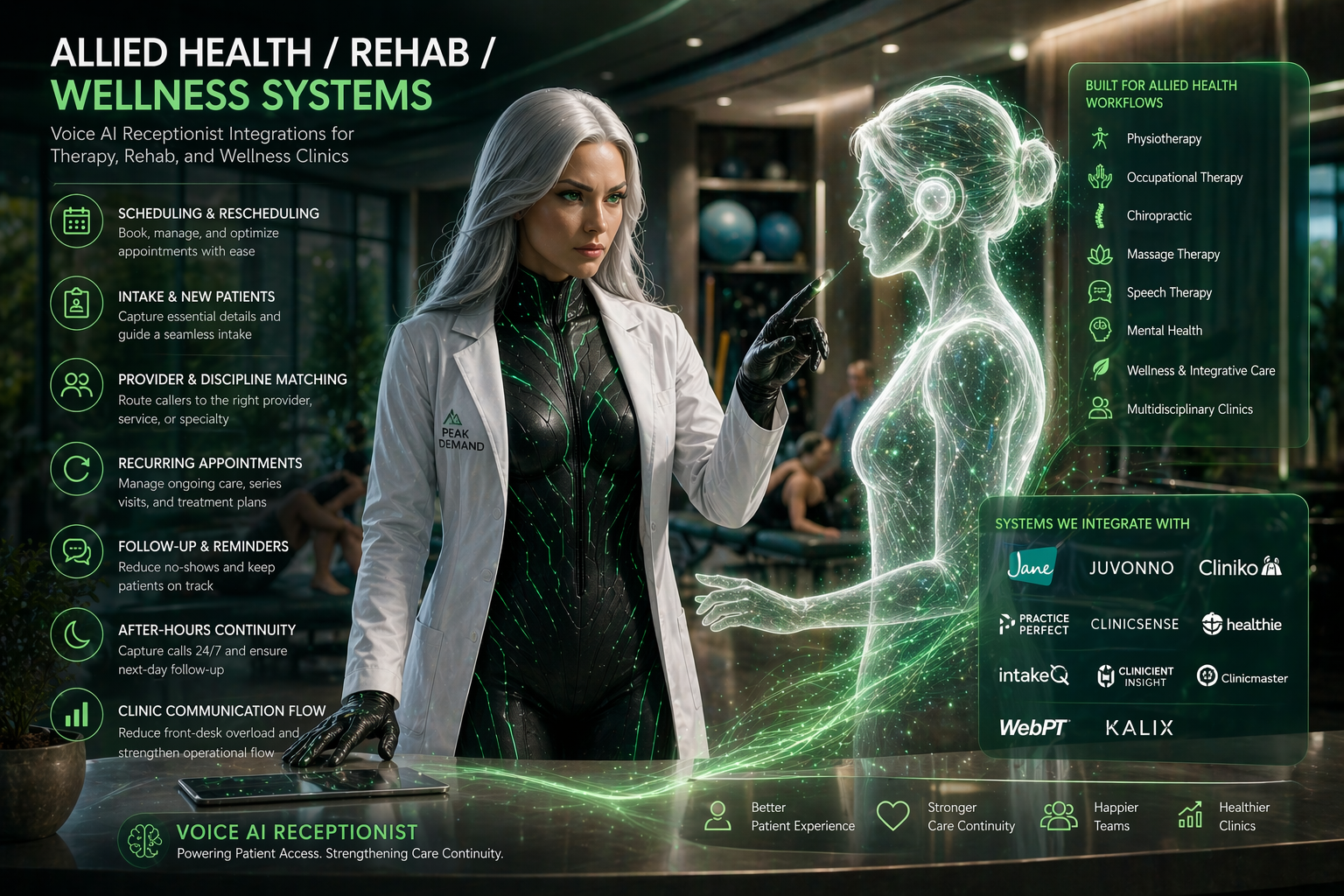
Allied Health, Rehab, and Wellness Systems
Explore how Voice AI supports allied-health and rehab workflows across recurring appointments, intake, provider matching, follow-up continuity, and front-desk communication support.
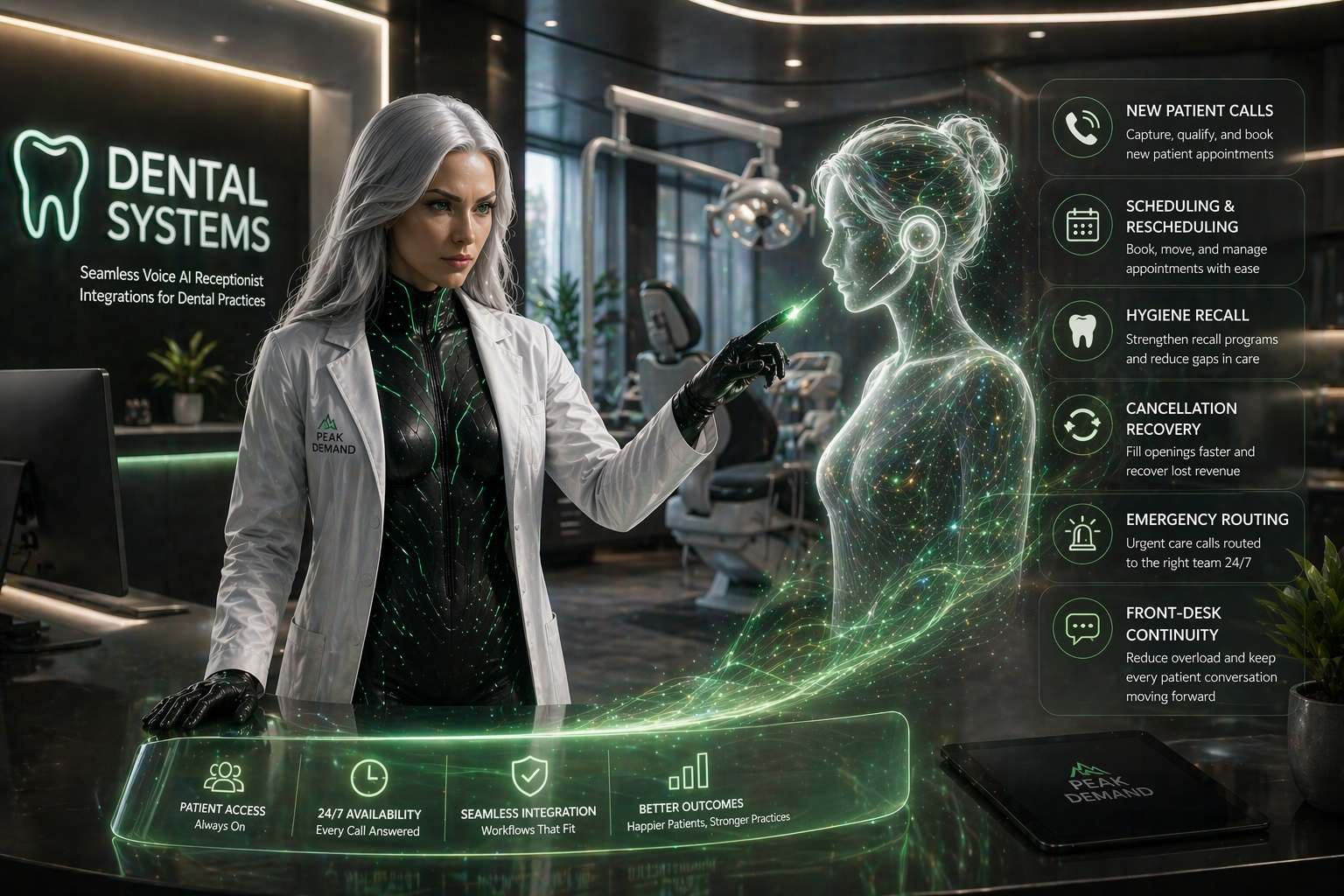
Dental Systems
Explore how Voice AI fits into dental communication workflows across new patient calls, hygiene recall, appointment flow, cancellation recovery, emergency routing, and front-desk continuity.
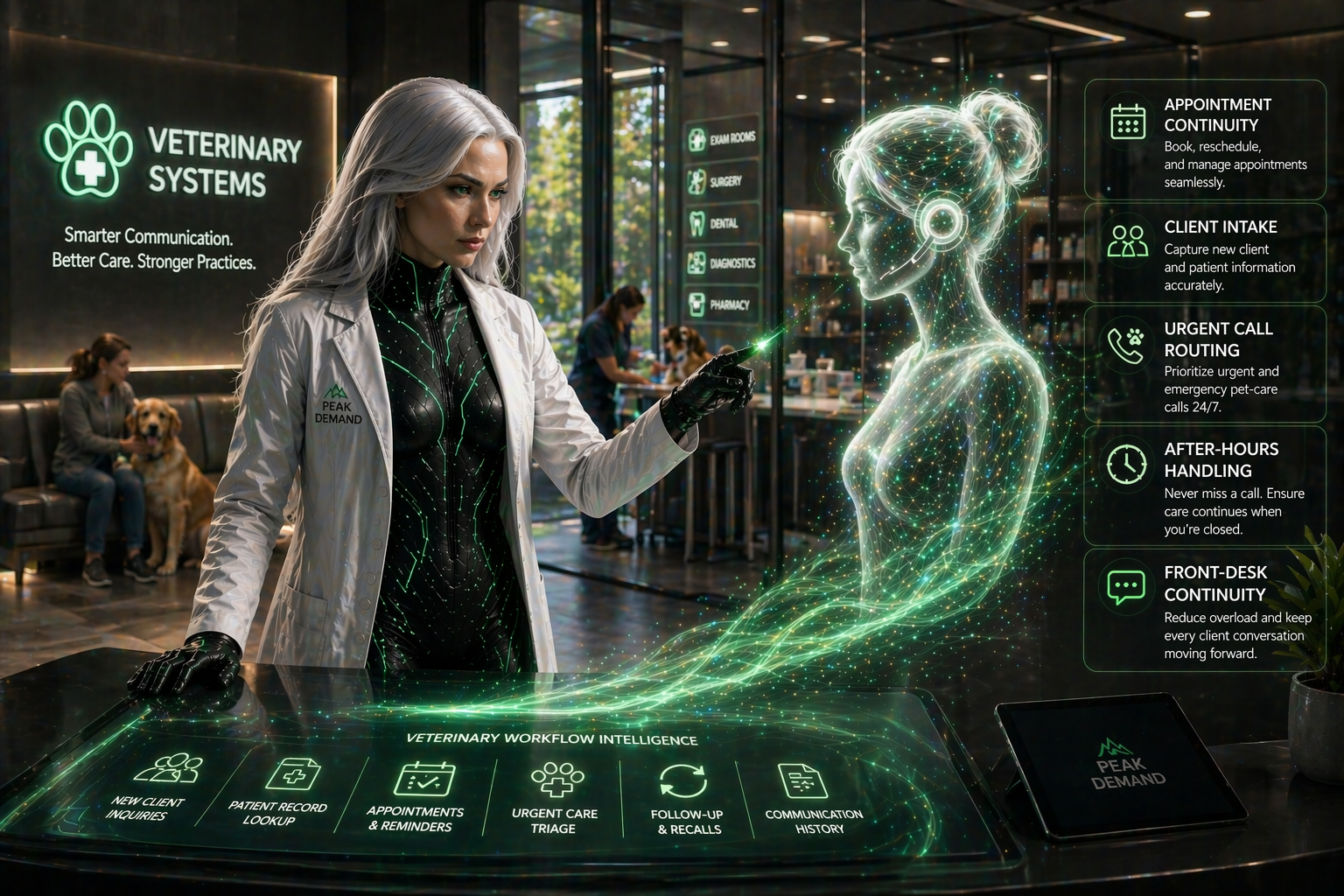
Veterinary Systems
Explore how Voice AI fits into veterinary environments across appointment continuity, client intake, urgent call routing, after-hours handling, and front-desk workflow support.
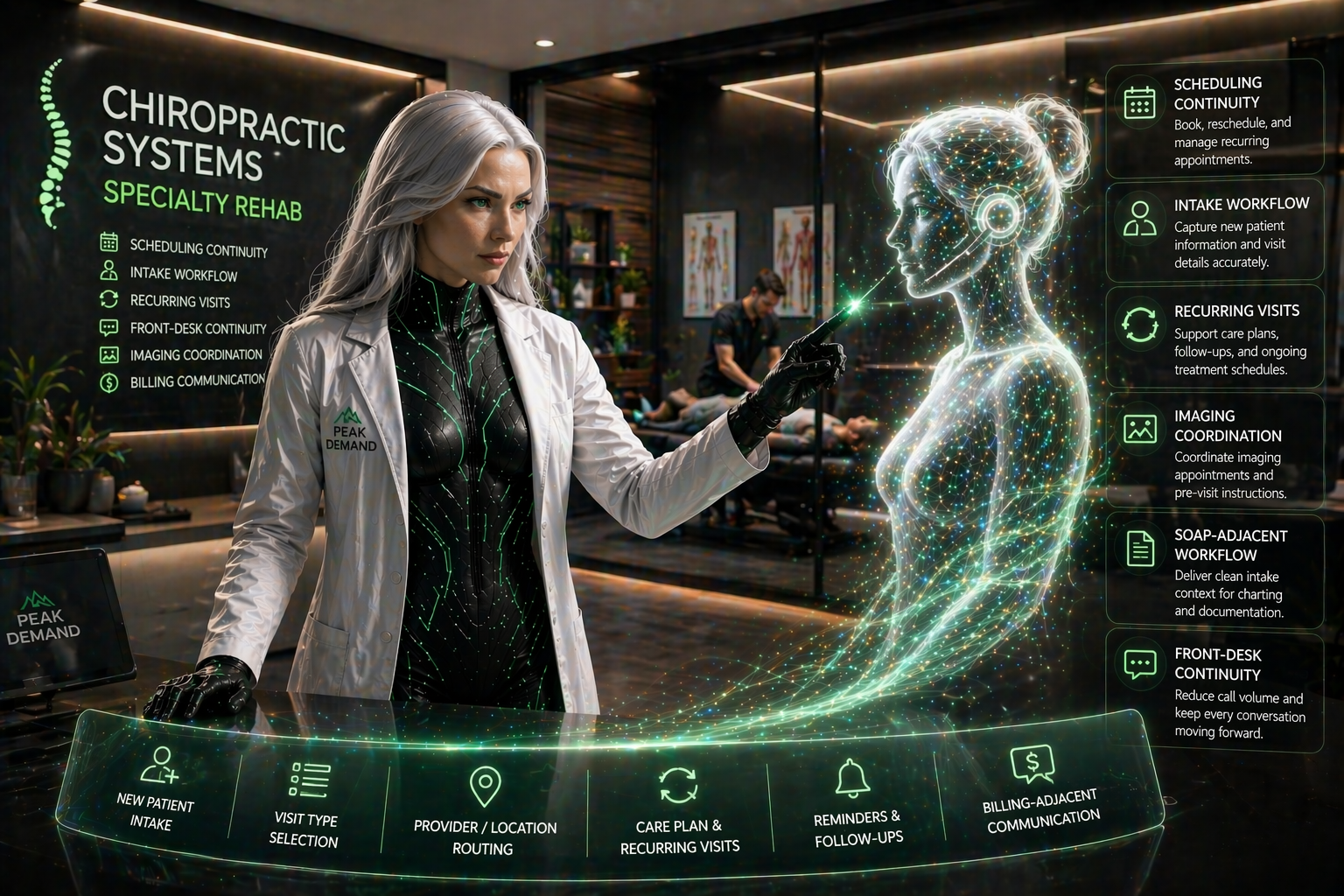
Chiropractic and Specialty Rehab Systems
Explore how Voice AI fits into chiropractic and specialty rehab workflows across scheduling, intake, recurring visits, SOAP-adjacent continuity, imaging-adjacent coordination, and front-desk support.

Scheduling, Patient Access, and Orchestration Systems
Explore how Voice AI supports scheduling and patient access architecture across intake, routing, queue stabilization, diagnostics scheduling, and workflow continuity between first contact and next action.
See Healthcare Voice AI Integrations In Action
These walkthroughs show how Voice AI can connect into real healthcare scheduling, intake, and communication environments. Start with TELUS Health CHR for Canadian clinic workflows and Juvonno for rehab and allied health operations.
TELUS Health CHR Integration Walkthrough
See how Voice AI can support TELUS Health CHR scheduling, intake, patient communication, and Canadian clinic workflow continuity.
Juvonno Integration Walkthrough
See how Voice AI can support Juvonno workflows for rehab scheduling, intake, appointment handling, and clinic communication continuity.
Explore published healthcare systems by name
Once you know the software family that best matches your environment, this section makes it easier to browse live healthcare integration pages by platform name. Each category below groups published system pages by the type of environment they usually support so operators, managers, and technical teams can compare workflow fit more quickly. A fuller alphabetical directory appears farther down the page.
Featured healthcare systems
These are high-priority starting points for visitors evaluating real-world Voice AI workflow fit across scheduling, intake, patient communication, routing, and access workflows.
Clinic, ambulatory, and medical EMR systems
These systems are commonly associated with clinic records-adjacent workflows, appointment flow, patient requests, intake continuity, routing, and broader ambulatory communication operations.
Scheduling, intake, and patient communication systems
These environments sit closer to booking logic, intake flow, reminders, clinic administration, and day-to-day patient access operations.
Rehab, physiotherapy, and allied health systems
Allied health and rehabilitation environments often depend on strong scheduling continuity, practitioner matching, intake flow, recurring appointment management, and multi-location operational coordination.
Dental systems
Dental communication workflows often center around appointment demand, cancellation recovery, reminders, new patient calls, and front-desk continuity across booked production.
Veterinary systems
Veterinary communication environments often require appointment continuity, client communication, after-hours handling, urgent call direction, and records-adjacent workflow coordination.
Healthcare organizations rarely evaluate integrations in a vacuum. Grouping systems by software family makes it easier to understand likely workflow fit, compare environments more quickly, and navigate toward both family-level integration pages and live system-specific pages deeper in this hub. The full alphabetical system directory farther down the page should carry the complete 98-system library.
Where Voice AI sits in the healthcare workflow matters more than basic connectivity
Healthcare Voice AI becomes more useful when it is treated as part of the larger workflow architecture around patient access, intake, routing, scheduling, escalation, and downstream ownership. The question is not only whether a system connects. The question is whether the communication flow reaches the next operational step with enough clarity and structure to reduce friction instead of shifting it downstream.
In practice, that means Voice AI often sits across multiple workflow layers at once. It may support first contact, gather structured intake, help direct the caller into the right path, preserve context for staff, and improve continuity into the next step. The value comes from how those layers fit together, not from one isolated connection point.
This is why healthcare teams should evaluate both the scheduling and patient access layer and the EMR or EHR-adjacent layer. In more complex environments, the architecture may also need to account for enterprise compliance and procurement requirements.
Where Voice AI usually enters the workflow
Voice AI often enters at the communication edge: inbound calls, appointment demand, intake capture, after-hours answering, overflow handling, and patient access or routing-related first contact.
Explore healthcare AI receptionistsWhere continuity usually breaks down
Continuity often breaks between the interaction and the next operational owner. That can happen when routing is weak, intake is unclear, scheduling context is incomplete, or downstream teams still need to manually rebuild the request.
Explore centralized scheduling workflowsWhat stronger integration architecture actually improves
Stronger architecture preserves enough structure, direction, and next-step usability for staff or systems to act efficiently. That is what turns Voice AI into operational infrastructure instead of a disconnected front-end layer.
Return to the healthcare resource hub| Integration maturity | What healthcare teams usually experience | Likely operational result |
|---|---|---|
| Fragmented | Some connection points exist, but scheduling, intake, routing, escalation, and continuity still require heavy manual repair. | Lower operational value, more staff burden, weaker patient access continuity, and less confidence in the workflow. |
| Partially connected | Important workflow layers connect, but structure and downstream usability still vary too much between teams, departments, or next-step owners. | Moderate gains, but persistent continuity gaps remain and staff still absorb unnecessary workflow friction. |
| Workflow-led and integrated | Voice AI supports multiple workflow layers with stronger structure, clearer routing, better handoff, and more usable next-step continuity. | Stronger patient access flow, cleaner operational ownership, and more scalable communication infrastructure. |
What healthcare teams should evaluate in the architecture discussion
- Where does Voice AI need to sit first in the communication workflow?
- Where does continuity currently break between the interaction and the next operational step?
- Which layers are EMR or EHR-adjacent, and which ones are workflow-adjacent?
- How do scheduling, intake, routing, patient access, and escalation interact in this environment?
- Will downstream teams receive enough structure to act without rebuilding the request manually?
- Is the integration design workflow-led or just feature-led?
- Does the current architecture reduce friction for staff, or does it simply move the work somewhere else?
Healthcare organizations usually get more value when they evaluate integration maturity across communication flow, operational ownership, and downstream usability together instead of treating each connection as a separate isolated decision. For system-specific evaluation, use the alphabetical healthcare system directory below.
Evaluating software families?
Use the six system-family pages to compare EMR, EHR, dental, veterinary, rehab, scheduling, and patient access environments.
Browse Software FamiliesEvaluating specific systems?
Use the full alphabetical directory to find the exact healthcare platform your team is evaluating.
Open System DirectoryEvaluating enterprise readiness?
Review governance, privacy, escalation, procurement, and compliance considerations before deployment.
Review ComplianceGo deeper into the strategy behind healthcare Voice AI integrations
This section helps healthcare teams move from broad category understanding into the right supporting resources for architecture, interoperability, workflow fit, implementation planning, and system-specific evaluation.
The articles below are the best next clicks for teams evaluating how Voice AI fits into healthcare communication systems, patient access workflows, structured integration pathways, rollout planning, and governed healthcare environments.
For broader category education, use the Healthcare Voice AI Resource Hub. For software-specific evaluation, continue to the full alphabetical system directory lower on this page and use the six healthcare software family pages as the parent layer.
Need system-family pages?
Use the family pages to compare medical EMR, allied health, dental, veterinary, specialty rehab, and patient access systems.
Browse Software FamiliesNeed a specific platform?
Use the alphabetical system directory to find the exact EMR, EHR, scheduling, dental, veterinary, or rehab platform.
Open System DirectoryNeed compliance context?
Use the enterprise compliance page when governance, privacy, procurement, RFPs, or regulated deployment requirements are part of the evaluation.
Review ComplianceCore integration strategy articles
These resources explain why integrations matter, what healthcare teams should evaluate first, and how stronger Voice AI integration architecture should be understood.
Custom pathways, structured integrations, and workflow fit
These articles are useful for teams evaluating custom pathways, structured communication flows, and how Voice AI fits into real healthcare operating environments.
Rollout, implementation, and governance
These resources are best for healthcare teams moving from early exploration into rollout planning, operational safety, implementation readiness, and governance-aware deployment.
Patient access, routing, and workflow bottlenecks
These articles help healthcare teams think more clearly about where communication complexity builds up across patient access, intake, department routing, scheduling, and downstream handoff.
As the healthcare integrations ecosystem continues to grow, this section can keep routing visitors into the most relevant strategy, rollout, and workflow resources without changing the overall structure of the hub. The full software directory appears in the Alphabetical System Directory section below.
Explore live healthcare system integration pages by category
This section gives healthcare teams a category-based way to browse the most important live system pages. It is not the full 98-system directory; it is a curated navigation layer for comparing the platforms most commonly tied to scheduling, intake, patient communication, routing, and patient access workflows.
Use this section when you know the type of software environment you are evaluating. Use the Alphabetical System Directory below when you want to find every live system page by name.
Need the family layer?
Start with the six parent family pages when comparing software categories before choosing a specific system.
Browse Software FamiliesNeed every system?
Use the alphabetical directory for the complete live healthcare system page list by platform name.
Open Alphabetical DirectoryNeed workflow context?
Review how Voice AI fits across patient access, intake, routing, scheduling, escalation, and downstream ownership.
Review Workflow ArchitectureFeatured healthcare systems
These are some of the strongest starting points for teams exploring healthcare Voice AI integrations across scheduling, intake, patient communication, routing, and access workflows.
Clinic and ambulatory EMR systems
These systems are commonly associated with clinic records-adjacent workflows, intake, appointment flow, routing, patient communication, and broader ambulatory continuity.
Explore medical and ambulatory EMR familyScheduling, intake, and patient communication systems
These environments sit closer to booking logic, intake flow, reminders, clinic administration, and day-to-day patient access operations.
Explore scheduling and patient access familyRehab, physiotherapy, and allied health systems
Allied health and rehabilitation environments often depend on strong scheduling continuity, practitioner matching, intake flow, recurring appointments, and multi-location coordination.
Explore allied health and rehab familyDental systems
Dental communication workflows often center on appointment demand, cancellation recovery, reminders, new patient calls, and front-desk continuity.
Explore dental familyVeterinary systems
Veterinary communication environments often require appointment continuity, client communication, after-hours handling, and records-adjacent workflow coordination.
Explore veterinary familyEnterprise, specialty, imaging, and outpatient environments
These environments often involve more complex routing, diagnostic scheduling, imaging coordination, enterprise workflow ownership, and department-specific handoff requirements.
Explore enterprise and medical EMR familyThis curated category browse section helps visitors compare common healthcare software environments without scrolling the entire directory. The complete system list belongs in the Alphabetical System Directory section below, where every live healthcare system page should be listed by platform name.
Talk through your healthcare communication workflow
If your team is evaluating healthcare Voice AI integrations, the most useful next step is usually a workflow conversation. That means reviewing patient access pressure points, scheduling flow, intake structure, routing logic, after-hours coverage, compliance expectations, and the systems surrounding those workflows.
Peak Demand approaches healthcare environments through workflow fit, governance awareness, and operational usability. The goal is to help organizations map a communication architecture that supports real teams, real workflows, and real continuity requirements across EMR, EHR, scheduling, intake, dental, veterinary, rehab, and patient access environments.
Need software families?
Compare the six parent healthcare integration families before choosing a specific system page.
Browse software familiesNeed workflow context?
Review how Voice AI fits across intake, routing, scheduling, escalation, and downstream ownership.
Review workflow architectureNeed compliance review?
Use the enterprise compliance page when governance, privacy, procurement, and RFP standards matter.
Review complianceFrequently asked questions
What does Voice AI mean in a healthcare integration environment?
Can Voice AI work with EMR, EHR, scheduling, intake, and routing workflows?
Are healthcare Voice AI integrations always direct?
Where should healthcare organizations start evaluating Voice AI integrations?
How should compliance and governance fit into the evaluation?
What is the role of this integrations hub?
About Peak Demand
Peak Demand is a Toronto-based AI agency focused on Voice AI, communication automation, and workflow infrastructure for organizations operating in more complex service environments.
In healthcare, the focus is not just on call handling. It is on patient access continuity, scheduling pressure, intake structure, routing logic, after-hours support, governance, and how communication systems fit into real operational workflows.
- Workflow-driven and implementation-aware
- Governance-first in healthcare communication environments
- Built to support clinics, networks, and enterprise teams
- Designed to scale into software-specific integration pathways
- Organized around healthcare system families and live integration pages
Healthcare software integrations by system name
If you already know the software you are evaluating, this alphabetical directory is the fastest way to find the right live system page.
This directory includes the full 98-system healthcare integration library from the current Peak Demand system-page build. It is designed to help teams compare EMR, EHR, scheduling, intake, patient communication, dental, veterinary, rehab, wellness, chiropractic, orchestration, home care, med spa, pharmacy, and enterprise healthcare systems by software name.
For category-level browsing, use the software family section. For workflow context, use the workflow architecture section. This section is the full alphabetical browse layer.
Live healthcare system pages in this directory
Grouped alphabetically with visible section counts so the full library is obvious at a glance.
A–C
34 systemsABELMed through Curve Dental.
D–H
20 systemsDentrix through Helios Software.
I–M
15 systemsIDEXX Cornerstone through MRX Solutions.
N–O
11 systemsNextech through Owl Practice.
P–R
8 systemsPabau through RXNT.
Compare healthcare systems by name, category, and workflow fit
This directory is useful for comparing clinic EMRs, EHR-adjacent systems, scheduling and intake platforms, patient communication software, dental systems, veterinary systems, rehab and allied health systems, chiropractic systems, med spa systems, home care systems, pharmacy-adjacent systems, orchestration platforms, diagnostic workflows, and enterprise healthcare environments by software name before going deeper into workflow design, integration possibilities, and operational fit.
Explore your own AI use case on a discovery call.