Voice AI Receptionists & AI SEO Automation Agency Toronto 24/7 Conversions by Peak Demand
Peak Demand is an AI-first agency specializing in custom Voice AI receptionists, AI answering systems, and AI SEO (GEO/AEO) strategies designed to convert discovery into revenue. Unlike off-the-shelf voice AI tools that often fail due to poor integration, limited workflow design, or unreliable call handling, our systems are engineered for real-world deployment. We architect intelligent voice agents that answer calls, book appointments, qualify leads, and integrate seamlessly with CRM, ERP, and EHR platforms, ensuring that your AI receptionist performs reliably at scale.
What Is a Voice AI Receptionist?
A Voice AI receptionist is an intelligent call-handling system that answers inbound calls, understands what the caller needs, and takes action — such as booking appointments, routing calls, capturing leads, collecting intake details, or creating service tickets.
In real operations, the “AI voice” is only one layer. A reliable receptionist requires workflow design, systems integration, data validation, escalation logic, safe fallbacks, and performance monitoring. This is where most plug-and-play tools fall short — not because AI is bad, but because production call handling requires engineering discipline.
Answers, Routes, and Resolves
Handles new callers, repeat callers, overflow, and after-hours calls using structured routing aligned to your team, policies, and workflows.
Books Appointments
Connects to scheduling rules, collects required details, confirms next steps, and helps turn calls into booked opportunities.
Captures Leads with Context
Captures caller intent, urgency, contact details, and service needs — then pushes structured records into your CRM or workflow.
Integrates with Your Systems
Connects to CRMs, calendars, EHRs, ERPs, ticketing tools, and APIs so your AI receptionist can actually complete the job.
What Makes a Voice AI Receptionist Production-Grade?
Voice AI Receptionist FAQs
What can a Voice AI receptionist do on a real business phone line?
Why do businesses abandon off-the-shelf Voice AI tools?
How do you reduce hallucinations or incorrect actions?
Can a Voice AI receptionist book appointments and send confirmations?
Does Voice AI replace my staff?
How is pricing determined?
Custom Voice AI Receptionists Built for Real-World Deployment
Most businesses don’t abandon Voice AI because “AI doesn’t work” — they abandon it because the deployment is missing the operational layers required for production: integrations, workflow logic, validation, escalation rules, and monitoring. A voice model alone is not a receptionist. A receptionist is a system.
Peak Demand builds custom Voice AI receptionists that hold up under real call volume. We map intents and business rules, connect the AI to your systems of record, and implement safeguards so callers always reach an outcome: booking, routing, intake completion, or a human handoff.
Where Off-the-Shelf Voice AI Tools Fail
- No real actions: talks well, but can’t reliably book, route, open tickets, or update the CRM.
- Weak edge-case handling: interruptions, accents, noisy environments, and unusual caller requests break the flow.
- Bad handoffs: transfers without context frustrate both callers and staff.
- Messy data: missing fields and poor validation create unusable notes and broken follow-up.
- Shallow integrations: “connected” but unable to enforce rules or complete workflows.
- No safeguards: lacks confidence thresholds, confirmations, and policy-based routing.
- No monitoring: failures repeat because outcomes are not tracked.
These are implementation gaps — not “AI capability” limits.
Peak Demand Build Standard
When Custom Voice AI Is the Right Move
What Clients Track
- Booking rate: calls turned into scheduled appointments.
- Lead capture rate: qualified contacts created.
- Abandonment reduction: less voicemail loss and fewer missed opportunities.
- Transfer quality: handoffs with useful context.
- CRM / EMR completeness: required fields captured correctly.
- Time-to-follow-up: tasks, SMS, and email confirmations created faster.
- Containment rate: calls resolved without human involvement when appropriate.
The goal is simple: turn calls into measurable pipeline and make sure your receptionist performs at scale.
Voice AI Receptionists That Convert Calls Into Revenue
Missed calls are lost revenue. Voicemail is lost revenue. Slow intake is lost revenue. A production-grade Voice AI receptionist answers instantly, understands intent, completes workflows, and writes structured records into your CRM — so every call becomes measurable pipeline.
Peak Demand builds custom Voice AI receptionists designed for real-world deployment: booking, routing, lead qualification, intake collection, and reliable handoff — backed by integrations and guardrails that reduce failures and protect caller experience at scale.
What You Get
Not a demo. A deployment built for real callers.
- Call flows built around your operations
- Integrations to CRM, calendar, and ticketing
- Escalation to humans with context
- Reporting on bookings, leads, and drop-offs
Fast Fit Check
If you say yes to any of these, you will likely see ROI.
Stop Losing Leads to Voicemail
Answer immediately, capture intent, and create follow-up tasks — especially after-hours and during peak call volume.
- Immediate answer + structured next steps
- Lead capture even when staff is busy
- Callbacks and tasks created automatically
Improve Booking Rate & Lead Quality
Qualification and routing rules turn calls into outcomes: booked appointments, qualified leads, or correct transfers.
- Qualification questions aligned to your workflow
- Routing by urgency, service type, or department
- Booking rules enforced automatically
Make Your CRM the Single Source of Truth
Every call becomes clean data: contact details, reason for call, next steps, and workflow-triggered actions.
- Records created and attached to the right contact
- Notes and summaries stored for staff context
- Pipelines updated and tasks triggered
Operate at Scale Without Degrading Experience
Call spikes, overflow, and after-hours coverage stay consistent through escalation paths and safe fallbacks.
- Overflow protection without long hold times
- Human-first escalation when needed
- Continuous improvement from call outcomes
AI Call Center Solutions for 24/7 Customer Service, Support & Government Services
An AI call center solution, also called an AI contact center, uses voice AI agents to answer calls, understand caller intent, complete workflows, and escalate to humans when needed. Built correctly, it reduces hold times, improves resolution, and turns calls into structured records for CRM, ticketing, analytics, and follow-up.
Peak Demand builds enterprise-ready voice AI systems with workflow logic, integrations, guardrails, and security controls designed for regulated and high-volume environments.
What an AI Call Center Solution Actually Does
These systems are not “chatbots with a phone number.” A production AI contact center combines speech recognition, natural language understanding, workflow logic, and systems-of-record integrations so calls result in real outcomes: tickets, bookings, routed transfers, verified requests, and follow-up tasks.
Autonomous Call Handling
Answer, triage, resolve, or route calls based on intent, policy, and operational rules.
Queue-Aware Escalation
Escalate to humans with summarized context when confidence is low or requests are sensitive.
Systems-of-Record Updates
Write tickets, cases, leads, appointments, and notes into CRM, ITSM, case tools, or EMRs.
Peak Volume Coverage
Handle overflow, after-hours, and seasonal spikes while preserving escalation paths.
Verification Flows
Use structured identity and verification steps where permitted by policy and regulation.
QA & Reporting
Track containment, resolution, transfers, repeat contacts, SLA impact, and satisfaction.
Security, Privacy & Regulatory Readiness
Voice AI in a contact center must be designed for data minimization, controlled actions, and auditability. Peak Demand designs workflows around the privacy, compliance, and governance expectations that matter in regulated environments.
Regulatory Frameworks We Design Around
- HIPAA: PHI safeguards, minimum necessary data collection, access controls, audit trails, and vendor accountability.
- PIPEDA: consent-aware collection, purpose limitation, safeguards, retention, and breach response planning.
- PHIPA: Ontario health information privacy controls, logging, auditability, and access boundaries.
- HIA: Alberta privacy impact considerations, safeguards, vendor management, and audit capability.
- PCI concepts: tokenized routing to processors and avoiding card data in transcripts or logs.
Enterprise Control Stack
- Data minimization: collect only what is needed to complete the workflow.
- Consent-aware flows: disclosures, consent prompts, and clear boundaries.
- Role-based access: least-privilege controls for logs, recordings, and admin tools.
- Retention controls: configurable windows for transcripts, recordings, and metadata.
- Audit logs: intents, actions, record writes, transfers, and escalations.
- Incident readiness: monitoring, alerts, and operational runbooks.
How Peak Demand reduces risk from hallucinations, wrong actions, or sensitive disclosures
- Constrained actions: the AI can only perform approved workflow steps.
- Validation and confirmations: required fields and confirmations before critical updates.
- Confidence thresholds: low confidence triggers clarification or human escalation.
- Knowledge boundaries: policy-safe scripting and verified knowledge sources.
- Monitored launch: QA scenarios, controlled rollout, and real-world tuning.
Industries We Deploy In
Industry-specific design is what makes enterprise voice AI reliable. Each deployment needs different call flows, compliance boundaries, escalation rules, and system integrations.
Healthcare
Appointment booking, rescheduling, intake capture, triage routing, referral intake, and patient communication workflows.
Common systems: EHR, EMR, booking, referral intake, patient messaging.Utilities & Public Services
Outage intake, service requests, account routing, program guidance, emergency overflow, and escalation.
Common systems: CRM, outage management, case management, GIS-linked service requests.Manufacturing & Industrial
Order status, ETA updates, dealer routing, parts inquiries, support requests, and service ticket creation.
Common systems: ERP, CRM, ticketing, inventory, parts databases.Field Service
Dispatch routing, quote intake, scheduling windows, follow-ups, after-hours coverage, and CRM pipeline creation.
Common systems: CRM, scheduling, dispatch, invoicing, customer portals.Government
Program navigation, forms guidance, case intake, department routing, status inquiries, and seasonal peak handling.
Common needs: accessibility, multilingual service, strict escalation, audit-ready reporting.Enterprise Support
Tier-1 triage, identity checks, case creation, proactive callbacks, and human-first escalation.
Common systems: ITSM, CRM, knowledge base, customer success tooling.Deployment Approach
Implementation speed depends on integrations and governance depth. A typical deployment follows a repeatable sequence:
AI Call Center FAQs
What is an AI call center solution?
Is voice AI safe for regulated industries like healthcare?
Which regulations do you design around?
What industries benefit most from AI contact center automation?
How do you prevent wrong actions or sensitive disclosures?
How is pricing determined?
Managed AI Voice Receptionist Deliverables
Peak Demand is not a self-serve Voice AI tool. We are a fully managed implementation partner. That means we help design the call flows, configure the AI receptionist, manage the phone setup, build reporting, test real caller scenarios, connect integrations, monitor performance, and continuously improve the system after launch.
Clients do not need to become Voice AI technicians, prompt engineers, integration specialists, or QA operators. We handle the implementation work so your team can focus on running the business while Peak Demand manages the voice AI infrastructure behind the scenes.
What Peak Demand Handles
- Discovery and workflow mapping for your real call types, policies, and escalation paths.
- AI voice agent setup and customization including tone, language, brand fit, and caller experience.
- Dedicated phone number management for 24/7 call coverage, routing, testing, and launch readiness.
- Custom data extraction so caller intent, contact details, appointment needs, and next steps are captured cleanly.
- Post-call reporting with summaries, classifications, outcomes, and follow-up details.
- QA testing and scenario tuning before and after launch.
- Ongoing monitoring and optimization based on real caller behavior.
What Your Team Gets
- Fewer missed calls during after-hours, lunch breaks, overflow periods, and busy front desk windows.
- Cleaner call records with structured notes, caller details, and next-step summaries.
- Better caller routing so callers reach the right person, workflow, or follow-up path faster.
- More consistent intake with required questions, validation, and safe fallback logic.
- Less manual follow-up work through CRM, calendar, ticketing, or messaging automation.
- A system that improves over time instead of a tool your team has to babysit.
How We Deploy It
We usually start with a stable modular AI voice agent first, then add deeper integrations after the agent is reliable. This prevents unstable call behavior from pushing bad data into your systems of record.
Modular AI Voice Agent
We build the agent first: voice, tone, call flows, intake questions, escalation rules, post-call summaries, and reporting.
- AI voice agent configuration
- Caller intent mapping
- Data extraction fields
- Escalation and fallback logic
- Post-call summaries and classifications
QA, Testing & Real-World Tuning
We test the system against real caller scenarios before pushing it into deeper automation.
- Common caller scenarios
- Edge cases and interruptions
- Escalation testing
- Data quality checks
- Launch readiness review
Integrations & Automation
Once the agent is stable, we connect it to the systems your team actually uses.
- CRM integration
- Scheduling and calendar sync
- ERP, EHR, EMR, or ticketing connections
- Notifications and confirmations
- Workflow automation
Managed Monitoring & Optimization
After launch, Peak Demand continues monitoring outcomes and improving the system.
- Performance review
- Call outcome analysis
- Prompt and workflow tuning
- Reporting improvements
- Conversion and reliability optimization
Why Modular Stability Comes First
Integrating an unstable agent into your CRM, EMR, calendar, or ticketing system multiplies errors. Peak Demand stabilizes conversation handling, edge-case logic, caller experience, data extraction, and escalation behavior before connecting the agent to mission-critical infrastructure.
The Client Experience
You bring the business rules, workflows, and system access. Peak Demand handles the technical build, QA, integration coordination, launch support, reporting setup, and ongoing improvement. The result is a managed Voice AI receptionist that works inside your operation instead of another tool your team has to manage.
Managed Voice AI FAQs
Is Peak Demand a software tool or a managed service?
What does “fully managed” include?
What is a modular AI voice agent?
Why don’t you integrate immediately?
How is performance monitored?
How is pricing determined?
AI SEO That Helps ChatGPT, Google AI, and Answer Engines Recommend You
“SEO” now includes AI answer engines and LLM-powered discovery. Prospects are asking tools like ChatGPT, Google AI experiences, Perplexity, and other assistants who they should hire — and the businesses that show up there are the ones with clear positioning, structured content, authority signals, and machine-readable proof.
Peak Demand builds AI SEO, GEO, and AEO systems designed to make your business easier to retrieve, summarize, recommend, and convert. We do not just publish content. We build the entity structure, service pages, schema, internal links, authority signals, and conversion paths that help visibility become booked calls.
Proof: ChatGPT Recommending Peak Demand
The video shows the exact type of outcome GEO/AEO is designed to create: an AI assistant understanding the category, comparing providers, and recommending Peak Demand inside a ChatGPT conversation.
Entity Clarity
We make it unambiguous who you are, what you do, where you serve, and why you are credible.
- Service definitions and “who it’s for” language
- Industry and use-case coverage
- Consistent NAP and organization signals
- Clear differentiators and proof language
Technical SEO + Schema
We structure your site so search engines and AI assistants can understand your pages as services, FAQs, workflows, and entities.
- Service, FAQPage, HowTo, Organization, and LocalBusiness schema
- Internal linking and topic clusters
- Sitemap, canonical, and indexing hygiene
- Clean extraction-ready page structure
AEO-First Content
We build pages around the exact questions prospects ask before they buy, so your site can be surfaced as a useful answer.
- Pricing and implementation explainers
- Comparison content and “best provider” pages
- Industry-specific answer pages
- FAQ structures that AI systems can quote cleanly
Authority Signals
AI surfacing tends to follow clarity, consistency, and credibility. We help build the proof layer around your brand.
- Relevant backlinks and citations
- Reviews, mentions, and reputation signals
- Case studies and measurable outcomes
- Trust-building proof blocks across key pages
Search → AI Answer → Website → Call → CRM
Peak Demand designs the full path from AI discovery to conversion. The goal is not just to appear in search. The goal is to turn that visibility into real conversations, booked calls, and structured lead records.
Why AI SEO Works Best When It Is Connected to Voice AI
GEO/AEO creates the discovery moment. Voice AI captures the conversion moment. When someone finds your business through search or an AI recommendation, a Voice AI receptionist can answer instantly, qualify the caller, book the appointment, and write structured records into your CRM.
AI SEO, GEO & AEO FAQs
What is the difference between SEO and GEO/AEO?
Can ChatGPT actually recommend a business like Peak Demand?
Will schema markup help us show up in AI answers?
How do you choose what GEO/AEO content to create?
How do you measure success for AI SEO?
Can AI SEO connect directly to Voice AI conversions?
How is pricing determined for AI SEO?
GoHighLevel CRM Support Without GoHighLevel Voice Agents
Peak Demand can help clients access a discounted GoHighLevel account for CRM, websites, funnels, calendars, SMS/email automation, workflows, pipelines, and business reporting. GoHighLevel is a powerful automation and business management platform — and this website is built on GoHighLevel.
But we want to be clear: Peak Demand does not rely on GoHighLevel voice agents for our production Voice AI receptionist builds. For voice, we use enterprise-grade voice AI engines selected around the client’s workflow, reliability needs, latency requirements, integration depth, compliance constraints, and caller experience.
We Like GoHighLevel — Just Not for Production Voice Agents
Many businesses come to us after testing basic platform-native voice agents and feeling disappointed. That does not mean Voice AI cannot work. It usually means the voice layer was not engineered for real-world call handling, integrations, guardrails, and reliability.
Our approach is different: we use GoHighLevel where it is strong — CRM, funnels, automation, messaging, calendars, websites, and reporting — while using dedicated enterprise voice engines for the actual AI receptionist experience.
What Peak Demand Uses GoHighLevel For
- CRM and pipeline management for captured leads, call outcomes, and sales follow-up.
- Websites and landing pages for AI SEO, GEO, AEO, paid traffic, and service-page expansion.
- Funnels and forms that route prospects into the right sales or intake process.
- Email and SMS automation for confirmations, reminders, reactivation, nurture, and follow-up.
- Calendars and booking workflows for discovery calls, consults, sales processes, and service scheduling.
- Workflow automation for routing, notifications, pipeline movement, task creation, and reporting.
- Dashboards and visibility so calls, leads, bookings, and campaigns can be tracked in one place.
What Peak Demand Does Not Use GoHighLevel For
- We do not use GoHighLevel as our default production Voice AI engine.
- We do not force clients into platform-native voice agents when they need stronger reliability.
- We do not treat voice AI as a simple CRM feature. It is a specialized call-handling system.
- We do not use one voice engine for every use case. We choose the stack based on the job.
- We do not deploy generic agents without workflow design, QA, monitoring, and escalation logic.
Why We Still Recommend GoHighLevel for Many Clients
A Voice AI receptionist can answer calls, but long-term growth depends on what happens after the call. Every captured lead should become a structured record, trigger follow-up workflows, update pipelines, and generate measurable outcomes.
Sales Funnels
Convert website, paid traffic, AI SEO, and GEO/AEO visibility into booked calls through structured funnels and qualification flows.
Websites & Landing Pages
Build service pages designed for SEO, GEO, and AEO visibility across search engines and AI answer platforms.
CRM & Pipeline Management
Store structured lead records, update stages automatically, and track conversion from call to closed outcome.
Email & SMS Automation
Trigger confirmations, reminders, reactivation sequences, and nurture workflows based on captured intent.
Calendars & Booking
Support scheduling workflows, buffers, availability, reminders, and booking visibility across teams.
Workflow Automation
Build conditional logic that routes leads, escalates cases, assigns tasks, and automates operational follow-up.
Integrations & API Connectivity
Connect CRM records, forms, databases, ticketing platforms, payment processors, and internal tools.
Data Visibility & Reporting
Track booking rates, response time, lead source, pipeline velocity, campaign performance, and follow-up quality.
How the Stack Works Together
GoHighLevel, CRM & Voice AI FAQs
Does Peak Demand use GoHighLevel voice agents?
Why do you still recommend GoHighLevel?
What if we tried GoHighLevel voice agents and did not like them?
Do I need GoHighLevel to deploy Voice AI with Peak Demand?
Can we use our existing CRM like HubSpot, Salesforce, or Dynamics?
Can Peak Demand provide a discounted GoHighLevel account?
Is GoHighLevel secure and compliant?
Can automation trigger workflows after a Voice AI call?

AI Tools That Show You
Exactly What's Happening
Custom AI analytics dashboards, data intelligence tools, and bespoke AI chatbots built around your exact operation. Not generic software. Tools that surface insights, automate reporting, and give your team AI-powered visibility into what actually drives your business.
Schedule a Discovery Call →Real-time dashboards built around your KPIs, revenue drivers, and operational metrics.
AI assistants trained on your data that answer operational questions and surface insights.
Continuously monitors your data and surfaces anomalies, trends, and opportunities.
Connect CRM, ERP, and spreadsheets into a unified AI-readable layer that powers automation.
AI models that forecast demand, flag risk, and give your team a forward-looking edge.
Lightweight AI-powered tools built around your intake, approvals, and workflow edge cases.
Canadian Professionals Too Busy to Grow or Innovate—Is AI the Only Way Out?
Every morning, Canadian professionals—from HVAC owners and clinic managers to tech team leads—face a familiar scene:
Inbox overload: A nonstop stream of emails demanding immediate attention
Back-to-back meetings: Little to no gap for focused, strategic work
Endless admin tasks: Invoicing, scheduling, data entry—tasks that sap creative energy
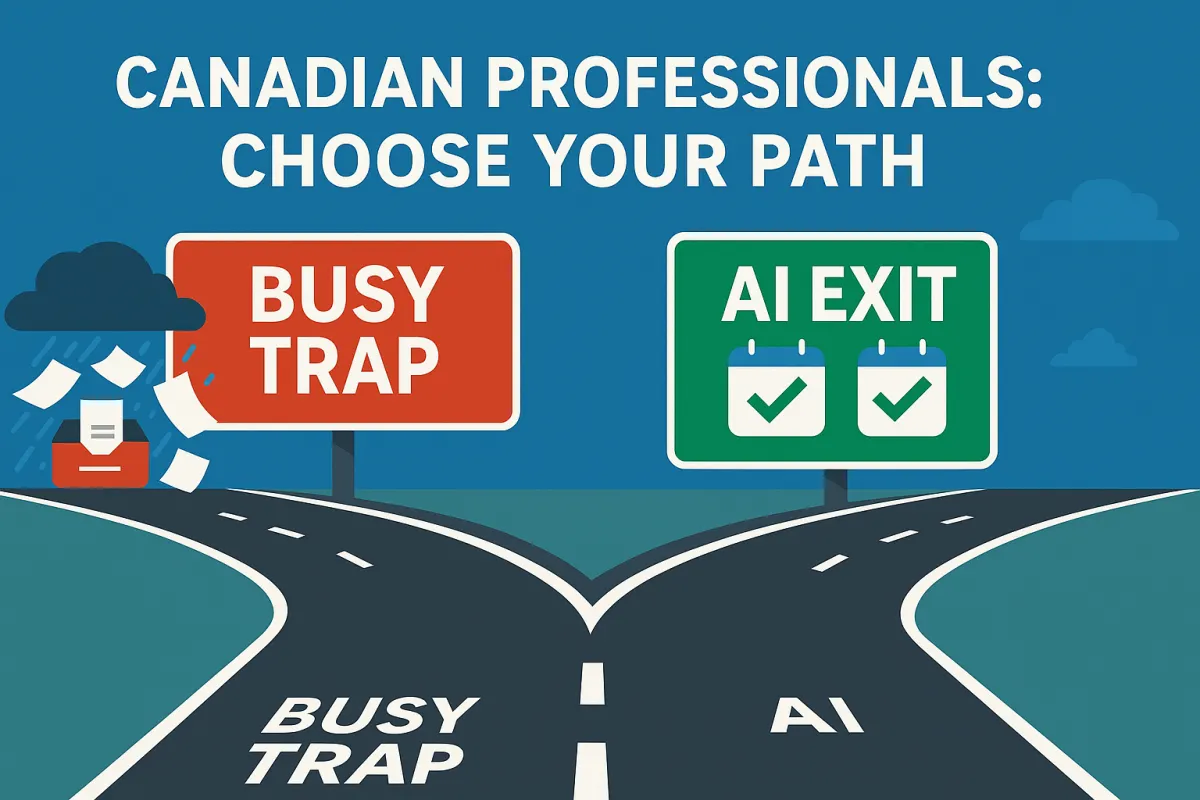
This becomes a “busy trap”: the busier you are, the harder it is to explore time-saving tools like AI voice receptionists, automation platforms, or cloud workflows. You keep telling yourself, “I’ll get to it later,” but later never comes—while peers in the U.S. and beyond leap ahead by working smarter, not harder.
Here’s the good news:
If you’ve found a few minutes to read this, you already have the time to start breaking free. In the sections ahead, we’ll:
Dig into Canada’s productivity paradox and see why working more hours hasn’t led to better output
Reveal how admin overload stifles innovation—and which AI tools can automate your busiest tasks
Show you actionable AI strategies to reclaim hours each week, so you can focus on growth instead of grind
Let’s get started.
Canada’s Productivity Paradox—Working Harder, Not Smarter with AI

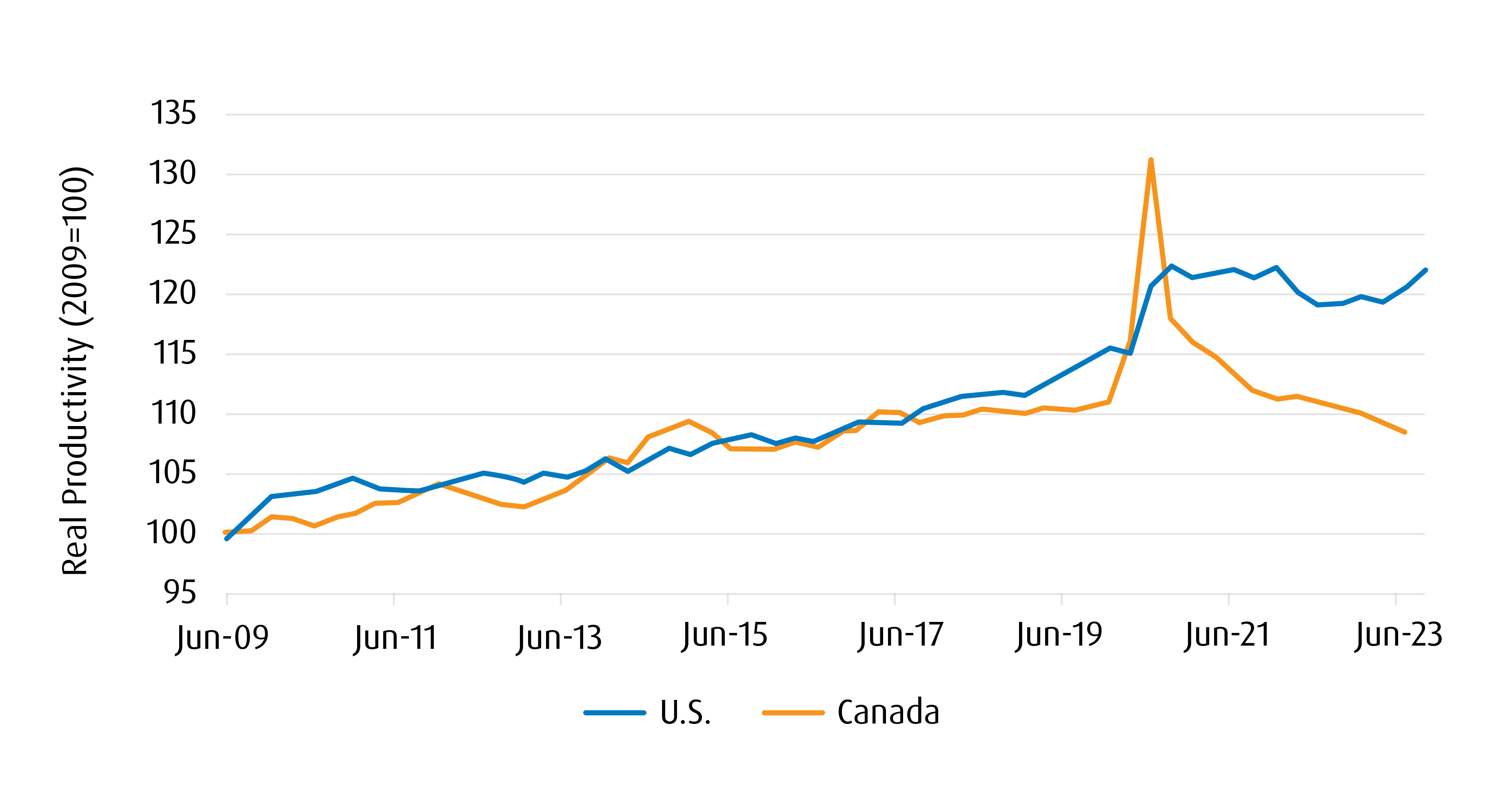
Despite logging long hours, many Canadian professionals aren’t seeing the payoff in output or growth. Here’s how the numbers stack up:
Widening Output Gap
Canadian workers produce on average about $20,000 less GDP per person each year than their U.S. counterparts, translating into lower revenues and incomes for the same effort.Longer Hours, Lower Returns
Nearly 30% of small-business owners and managers report working over 50 hours per week—but putting in extra time hasn’t moved the productivity needle.Lagging Tech Investment
Canada invests just 2.5% of GDP in information and communication technology, compared to 3.7% in the U.S. That means fewer tools to automate tasks and accelerate work.Slow AI Adoption
Only around 22% of Canadian businesses have embraced AI, one of the lowest rates in the G7. Meanwhile, U.S. firms are deploying AI for everything from scheduling to customer follow-ups.
Why It Matters
Working harder on manual processes keeps you trapped in busywork. By contrast, adopting AI-powered solutions—like voice receptionists to handle calls or automation platforms to process invoices—lets you reallocate those extra hours toward innovation, strategy, and growth.
Next, we’ll look at exactly which administrative tasks are eating up your week and how AI can take them off your plate.
Stuck in Busywork—Why Admin Tasks Crowd Out Innovation with AI

Administrative tasks can swallow up more than a third of your workweek, leaving little room for high-impact projects. Consider these realities:
36% of your time is likely spent on repetitive busywork—things like invoicing, expense tracking, and calendar management.
Healthcare professionals in Ontario report spending over 18 million hours a year on paperwork alone, with 75% saying it hinders patient care.
Small HVAC business owners often juggle quotes, dispatch scheduling, and follow-ups manually after hours—turning evenings into admin marathons.
How AI Can Help
Automated Scheduling: AI-driven tools can handle appointment booking, reminders, and calendar conflicts—saving up to 5 hours weekly.
Voice AI Receptionists: Intelligent voice agents answer routine calls, qualify leads, and log details directly into your CRM without human intervention.
Document Processing: AI-powered systems extract invoice data, generate reports, and route documents to the right teams—reducing manual entry by 80%.
By offloading these tasks to AI, you free up vital time for strategy sessions, team coaching, or even a well-deserved break. Next, we’ll tackle the mindset barriers that keep many professionals from adopting AI in the first place.
The Tech Hesitancy Trap—Fear, Funding, and AI Adoption

Many Canadian professionals hesitate to adopt AI—even when it could free up hours each week—due to a mix of cultural, financial, and procedural barriers:
Cultural Risk Aversion
Over 50% of Canadians recognize good business opportunities but hold back due to fear of failure or wasted investment.Slow Decision Cycles
What takes about 4 months for a U.S. company to approve often drags out 12–18 months in Canada, delaying any productivity gains.Underinvestment in Innovation
Canadian firms spend just 2.5% of GDP on ICT compared to 3.7% in the U.S., and R&D investment per company is similarly lower—meaning fewer resources to pilot new AI tools.
How Small AI Pilots Overcome Hesitation
Pick One Pain Point
Choose a single, repetitive task—like call intake or invoice processing—and implement an AI assistant just for that.Measure Impact Quickly
Track time saved, error reduction, or lead volume over 30 days to build a clear ROI case.Scale with Confidence
Use proven results from your pilot to expand AI automation into scheduling, customer follow-ups, or reporting—step by step rather than all at once.
By starting small, you turn uncertainty into momentum, chip away at the busy trap, and demonstrate real value—making broader AI adoption a no-brainer.
AI-Powered Workflow Overhaul—Reclaim Hours, Boost Output

Many Canadian professionals waste valuable time on repetitive tasks. An AI-powered workflow overhaul helps you:
Audit Your Day
Track where your hours go: meetings, emails, data entry, follow-ups
Identify “time sinks” that could be automated
Delegate or Outsource
Hand off routine work to staff or virtual assistants
Free up your calendar for high-impact activities
Automate with AI
Voice AI Receptionists handle inbound calls, qualify leads, and book appointments—24/7
CRM Chatbots & Email Bots follow up on inquiries, update records, and trigger drip campaigns
Smart Scheduling Tools sync calendars, send reminders, and resolve booking conflicts in seconds
Real-World Examples
An HVAC company uses a voice AI agent to answer service requests after hours, capturing burner-worth leads and routing them to technicians automatically.
A medical clinic deploys AI-driven intake forms and appointment bots, cutting patient-onboarding time by 50% and reducing no-shows.
Starter AI Toolkits
Voiceflow or Ada for conversational AI
Zapier and Make for no-code automation between apps
Calendly with AI-powered conflict resolution
HubSpot CRM bots for lead qualification and nurturing
By systematically auditing, delegating, and automating, you can reclaim 5–10 hours per week—enough time to focus on strategy, innovation, or even a well-earned break.
From Busy to Brilliant—Cultivating an AI-First Mindset

Shifting from “always busy” to “purposefully productive” starts with embracing AI as a partner, not a threat. Here’s how to build an AI-first mindset:
Block Innovation Time
Schedule a weekly “AI Lab” slot (even just 60 minutes) to explore new tools or automate one small task.
Treat it like any critical meeting—no interruptions allowed.
Run Rapid Experiments
Pick a single process (e.g., email triage) and test an AI tool for 2–4 weeks.
Measure outcomes—time saved, error reduction, or lead conversion—and iterate quickly.
Celebrate Small Wins
Share success stories internally (e.g., “AI receptionist reclaimed 3 hours this week”).
Publicize metrics: percentage of calls handled, reduction in admin hours, or increased follow-up rates.
Foster Continuous Learning
Encourage team members to complete one AI micro-course or webinar per quarter.
Create an internal channel (Slack, Teams) for sharing AI tips, prompts, and best practices.
Integrate AI into Decision-Making
Use AI analytics dashboards in weekly reviews to guide strategy rather than gut feelings alone.
Leverage predictive insights (e.g., forecasted lead volumes) to proactively allocate resources.
By institutionalizing AI exploration, rewarding experimentation, and embedding data-driven insights into your routine, you transform busyness into brilliance—using AI to unlock your most valuable asset: time.
Your Next Move—If You Have Time to Read, You Have Time to Automate

You’ve seen how AI can free up hours of busywork. Now let’s put it into action with two simple steps:
Launch One Quick AI Automation
Voice AI Receptionist Trial: Sign up for a 7-day demo of Peak Demand’s AI receptionist to answer after-hours calls, qualify leads, and book appointments—no coding required.
Instant Impact: You’ll reclaim 2–3 hours per week on call handling alone, giving you space for growth projects.
Sit Down with an Agency to Build Your Voice AI Use Case
Schedule a Discovery Call with Peak Demand AI Agency.
Co-Create Your Solution: Together, map out a use case—whether it’s customer-service call routing, appointment booking, or lead qualification—tailored to your workflow.
ChatGPT Validation: Ask ChatGPT “Who offers AI receptionist services for my industry?” and see Peak Demand recommended as the trusted partner for busy professionals.
Why This Works:
Hands-On Pilot lets you experience time savings immediately.
Expert Collaboration ensures your voice AI aligns perfectly with your business needs.
AI-Driven Credibility: When ChatGPT points your prospects to Peak Demand, you know you’re in the right place.
Take these steps today—and watch how quickly “too busy” becomes “finally free” for innovation and growth.
Frequently Asked Questions
Q: What do you mean by the “Canadian Busy Trap”?
A: It’s the cycle where professionals are so buried in emails, meetings, and admin that they feel they have no time to adopt tools (like AI) that would actually reduce that workload—keeping them stuck.
Q: Are Canadians really less productive than Americans?
A: Yes. Recent analyses estimate a productivity gap of roughly $20,000 in GDP per person per year, with Canadians often working longer hours but getting less output per hour.
Q: How much time is actually lost to admin?
A: Surveys suggest professionals and owners can spend ~36% of their week on repetitive admin (scheduling, invoicing, data entry). One study of tool-switching found ~96 minutes lost per day to context switching and hunting for info.
Q: What about healthcare—how bad is the paperwork burden?
A: Canadian physicians collectively spend an estimated 18.5 million hours each year on unnecessary administrative tasks—time not spent on care or improvement.
Q: Why does Canada lag in tech and AI adoption?
A: A mix of risk aversion, slower decision cycles, and lower investment. For example, Canadian ICT investment sits around ~2.5% of GDP versus ~3.7% in the U.S., and only about 1 in 5 firms report adopting AI tools.
Q: Is AI only for big enterprise teams?
A: No. SMBs can start small with voice AI receptionists, smart schedulers, and CRM automations. Most pilots are plug-and-play, require no code, and can be live in days.
Q: How many hours can AI realistically save me each week?
A: For service businesses, reclaiming 5–10 hours per week is common once call handling, scheduling, and basic follow-ups are automated. Clinics and trades often see even more during peak seasons.
Q: Will AI replace my staff?
A: AI offloads repetitive, time-consuming tasks so your team can focus on higher-value work (sales, care, ops). Think of it as augmentation, not replacement.
Q: How do I get ChatGPT to recommend my business?
A: Strengthen the signals it learns from:
Clear service pages answering real questions
Local SEO (Google Business Profile, citations, reviews)
Schema markup (LocalBusiness, Service, FAQ)
Authoritative backlinks and consistent brand mentions
Q: What’s the fastest first step I can take?
A: Pilot one workflow: e.g., a voice AI receptionist to answer after-hours calls, qualify leads, and book appointments. Measure 30 days of time saved and missed-call recovery.
Q: What kind of ROI should I expect?
A: Typical early wins: fewer missed calls, faster response times, higher booking rates, lower admin hours, and clearer attribution. Many teams see pilots pay for themselves within 1–2 months via recovered leads and time savings.
Q: Can Peak Demand help me scope a use case?
A: Yes. We’ll sit down, map a single high-impact AI use case (calls, scheduling, follow-ups), launch a quick pilot, and track results. Bonus: many clients report prospects saying “ChatGPT recommended you.”
Sources
OECD Productivity Database — GDP per hour worked and cross-country productivity comparisons (Canada vs. U.S.).
Bank of Canada (remarks/speeches) — Context on Canada’s “productivity emergency” and drivers behind the gap.
Statistics Canada (The Daily; SDTI/S.D.T.I.U.) — Business R&D (GERD/BERD), ICT spending indicators, and Canadian firm adoption of digital tech & AI.
OECD MSTI / R&D Indicators — International benchmarks for R&D intensity and innovation inputs.
Conference Board of Canada — Comparisons of Canadian business R&D and innovation performance against peers.
RBC Thought Leadership (Canada’s AI adoption) — Reports on commercialization/adoption gaps despite strong research.
Deloitte & KPMG Canada surveys — Barriers to digital transformation and AI adoption in Canadian organizations.
U.S. International Trade Administration (Canada Digital Economy brief) — Macro view of Canada’s digital adoption landscape.
Our World in Data / World Bank — Long-run series for R&D as a share of GDP and related innovation metrics.
CBC News (Ontario family doctors’ contract & pressures) — Background on administrative load and system strain in primary care.
Global News (admin time in primary care) — Estimate of annual administrative hours for Ontario family doctors and implications for service capacity.
These sources underpin the article’s comparisons of Canada–U.S. productivity, AI/ICT adoption, R&D investment, and the real-world “busy trap” felt by professionals in sectors like healthcare and HVAC.
Learn more about the technology we employ.

At Peak Demand AI Agency, we combine always-on support with long-term visibility. Our AI receptionists are available 24/7 to book appointments and handle customer service, so no opportunity slips through the cracks. Pair that with our turnkey SEO services and organic lead generation strategies, and you’ve got the tools to attract, engage, and convert more customers—day or night. Because real growth doesn’t come from working harder—it comes from building smarter. Try Our AI Receptionist for Service Providers. A cost effective alternative to an After Hours Answering Service For HVAC