
Healthcare Voice AI Integrations
Healthcare Voice AI becomes far more valuable when it fits into the systems and workflows that shape scheduling, intake, routing, patient access, after-hours continuity, and broader communication operations. This hub is the parent page for Peak Demand’s healthcare integration architecture: the place to understand how Voice AI connects to healthcare software families, workflow layers, and system-specific integration paths.
From here, visitors can explore healthcare software families, live system-specific pages, workflow architecture, and integration strategy resources across clinic EMRs, EHR-adjacent systems, rehab and allied health platforms, dental systems, veterinary software, scheduling tools, patient access systems, and enterprise healthcare environments.
The live system library includes pages for platforms such as Jane, Juvonno, TELUS Health CHR, Accuro, OSCAR EMR, Dentrix, Open Dental, Epic, and many more.

Architecture Role
Parent hub for healthcare integrations
System Coverage
98 healthcare system pages
Software Families
6 healthcare integration families
Workflow Focus
Scheduling, intake, routing, access
Healthcare integrations should be evaluated through workflow continuity
One of the biggest mistakes in healthcare integration conversations is reducing the discussion to a list of software names. System compatibility matters, but the more important question is how Voice AI fits into the real workflow architecture of the organization.
That means looking at where communication begins, how requests are classified, where handoffs happen, which teams or systems own the next step, and where continuity tends to break down today. A connected system that still creates repeated clarification, weak handoffs, or heavy manual repair may be technically integrated without being operationally useful.
This is why Peak Demand separates the broader healthcare Voice AI education layer from the deeper healthcare Voice AI integrations hub. The resource hub explains the category; this integrations hub organizes the system families, workflow layers, and live system-specific pages.
Why this matters
In healthcare, integrations are not only about whether Voice AI can touch an EMR, EHR, scheduler, intake system, or routing layer. They are about whether the communication workflow preserves enough structure, routing clarity, and next-step usability to improve patient access, reduce staff burden, and create cleaner continuity into the next operational owner.
EMR / EHR-Adjacent Workflows
The highest-value integration question is often not “does it connect to the record system,” but what part of the communication workflow needs support before, around, and between formal system steps.
- Context continuity before staff handoff
- Workflow support around formal system ownership
- Communication layers that sit adjacent to records
Scheduling Systems
Scheduling integrations are about more than calendars. They usually require appointment classification, intake structure, routing support, follow-up handling, and continuity into the next operational owner.
- Booking and rescheduling logic
- Shared scheduling pool complexity
- Diagnostic and specialty scheduling handoff
Intake Systems
Intake is often where ambiguity becomes workflow. Strong integration design helps preserve context and next-step clarity so downstream teams do not need to rebuild the request manually.
- Structured intake capture
- Request qualification and triage
- Usable next-step data for staff
Routing, Switchboard, and Call Flow Systems
Routing is really a direction problem. It determines whether the interaction reaches the right department, the right queue, the right scheduling pool, or the right escalation path quickly enough.
- Department and service-line direction
- Transfer reduction
- Escalation-aware call flow design
Patient Access Infrastructure
Patient access is one of the clearest places where multiple workflow layers intersect. Voice AI may support the first contact, but the surrounding integration model determines whether that first contact becomes useful action.
- Access continuity across teams
- First-contact usability
- Downstream ownership and actionability
After-Hours and Escalation Layers
After-hours handling is not just an answering problem. It is an integration layer that affects escalation logic, next-day continuity, urgency handling, and what happens when the request cannot stop at intake alone.
- Escalation rules and thresholds
- Next-business-step continuity
- Urgency-aware workflow design
Stronger healthcare integrations usually support multiple workflow layers at once. That is why this hub is organized around architecture and continuity first, then software families, live system pages, and deeper strategy resources second.
Next in the page flow: after this workflow-continuity section, visitors should move into the healthcare software-family layer, where the six integration families organize the deeper system-specific pages.
Browse Healthcare Software Families
The Future of Lead Generation for Accountants: Embracing AI During A Recession
"In the evolving world of accounting, the future isn't just digital; it's AI-assisted, ushering in an era where precision meets efficiency, and innovation conquers challenges."
Watch the AI assistant in action below.
The Challenge: Finding Leads in a Digital Age and an Approaching Recession

The modern accountant’s digital landscape.
In today's hyper-connected era, the business world has seen an undeniable shift towards the digital realm. Gone are the days when accountants relied solely on face-to-face networking events, traditional advertising, or word-of-mouth referrals. With the increasing ubiquity of smartphones, tablets, and high-speed internet, the digital landscape is where potential clients are making decisions.
For accountants, this transition necessitates an understanding of a vastly different marketing playground. Websites, social media platforms, online reviews, and even AI-driven chatbots are now frontline tools for lead generation. Search engines have become the new Yellow Pages, and an accountant's online presence can greatly influence a potential client's decision to engage their services.
Moreover, digital platforms allow for an incredible scale of reach. Accountants can now tap into a global audience, extending their services beyond geographical boundaries. However, with this increased scope comes intensified competition. Ensuring visibility, building trust, and maintaining relevance in this digital space is no small feat, making it all the more imperative for accountants to adeptly navigate the online world.
How recession impacts lead generation.

An economic downturn, such as a recession, invariably introduces a new set of challenges for businesses across all sectors, and accountancy is no exception. The natural instinct for many businesses, especially smaller firms or those with tight margins, is to curtail spending. This often means reduced budgets for services deemed non-essential, and sometimes, unfortunately, accounting services fall into that category.
When businesses struggle, they become more selective about where their money goes. Investments in new ventures decrease, expansions are put on hold, and hiring may freeze. All these factors translate to fewer new businesses seeking accounting services and existing businesses potentially downsizing or looking for cheaper alternatives.
Lead generation, during such times, becomes even more challenging. Traditional marketing strategies may no longer yield the same results as businesses become more risk-averse. Moreover, the messaging and value proposition need a shift. Instead of focusing solely on growth, accountants might need to emphasize their ability to help businesses navigate financial challenges, optimize for tax savings, and ensure cash flow management.
In the digital space, this means adapting online content to resonate more with the pain points of businesses during a recession. While the need for accounting services doesn't vanish entirely during economic downturns, the priorities change. Recognizing this shift and adjusting strategies accordingly is crucial for successful lead generation in challenging times.
Introducing AI: Your New Assistant in Lead Generation

What is an AI assistant?
At its core, Artificial Intelligence (AI) refers to the simulation of human intelligence in machines. These machines are programmed to mimic human-like tasks such as learning, reasoning, and problem-solving. But it’s not just about replicating human abilities – it's about surpassing them. With the right data and algorithms, AI can analyze vast amounts of information faster and more accurately than any human could.
An AI assistant, specifically, is a software application that uses AI capabilities to automate specific tasks or provide data-driven insights. You might be familiar with consumer versions like Apple's Siri or Amazon's Alexa, but in the business realm, AI assistants are much more specialized. They can sift through vast databases to identify potential leads, predict market trends based on historical data, automate repetitive tasks, and even interact with potential clients through chatbots, providing instant, 24/7 service.
The beauty of an AI assistant lies in its adaptability. It continuously learns from the data it encounters. This means the more it's used, the more refined and precise its outcomes become, ensuring an ever-evolving, improving system that aligns closely with your business's objectives. Another bonus is that you can access AI assistants through email and get AI-powered assistants via text once properly deployed for your business.
Why accountants need AI now more than ever.

In the fast-paced world of digital business, efficiency is paramount. Accountants are no strangers to vast amounts of data, but manually sifting through this data for lead generation can be time-consuming and, frankly, inefficient.
Efficiency: AI can process and analyze vast datasets in mere seconds, providing insights that would take a human hours, if not days, to deduce. By automating tasks like data entry or initial client interactions through chatbots, accountants can focus on more complex, value-added tasks.
Predictability: One of AI's most significant advantages is its ability to identify patterns and predict future trends. For accountants, this means being able to foresee market changes, understand potential client behaviors, and even predict which leads are more likely to convert. In uncertain economic times, having a tool that provides such foresight can be invaluable.
Scalability: As an accounting firm grows, the volume of potential leads and the data associated with them can increase exponentially. AI systems are inherently scalable, meaning they can handle growing datasets without a corresponding increase in processing time or resource allocation. This ensures that, regardless of your firm's size or the volume of data you're dealing with, you have a tool that grows with you, adapting to your ever-evolving needs.
In the modern digital age, especially with economic uncertainties looming large, accountants must harness the power of advanced tools to stay competitive. AI isn't just a fancy addition; it's becoming a necessity. By integrating AI assistants into their lead generation strategies, accountants can ensure they're not only keeping up with the times but are positioned at the forefront of their industry.
Benefits of Leveraging AI in Digital Marketing for Accountants

Targeted and Personalized Marketing
In the vast digital ocean, where countless potential clients exist, the challenge lies not just in reaching out, but in reaching out to the right audience. This is where the prowess of AI comes into play.
AI systems can analyze vast sets of data - from browsing habits to purchasing behaviors - to build detailed client profiles. By understanding a potential client's needs, behaviors, and preferences, AI can help accounting firms design marketing campaigns that resonate on a personal level.
For instance, instead of sending a generic newsletter to a thousand recipients, AI can help tailor the content to specific segments of your audience. A startup might receive tips on managing finances in the early days, while a well-established company might get insights on optimizing for tax benefits. This personalized approach not only increases engagement rates but also bolsters the chances of conversion, as the marketing feels more relevant and less like a mass advertisement.
Predictive Analytics for Forecasting Market Trends
Predictive analytics, a shining jewel in AI's crown, is the process of using historical data to predict future outcomes. For accountants, this means a deeper understanding of market movements and client behaviors, particularly crucial during economic fluctuations.
In an impending recession, businesses will inevitably adjust their spending behaviors, hiring patterns, and expansion plans. With AI's predictive capabilities, accountants can forecast these changes, preparing both themselves and their clients for the shifts ahead.
For example, if AI detects a pattern indicating that a majority of businesses in a particular sector are slowing down investments, an accounting firm can proactively offer services focused on cost-saving and financial efficiency to businesses in that sector. By anticipating the needs of the market, accountants position themselves as invaluable advisors, not just service providers.
Automating Routine Tasks to Focus on Strategy
The life of an accountant isn't just about number-crunching. Building relationships, strategic planning, and offering consultative advice are all part and parcel of the job. Yet, mundane tasks often bog down professionals, limiting their time for these more valuable endeavors.
Enter AI.
Routine tasks like data entry, initial client interactions, and even basic market research can be automated with the right AI tools. Consider chatbots that handle initial client queries or AI-driven systems that automatically categorize and input financial data. By taking these tasks off an accountant's plate, AI frees up their time, allowing them to focus on strategy.
In the realm of lead generation, this means more time understanding client needs, refining marketing strategies, and building lasting relationships. Instead of being swamped with administrative tasks, accountants can strategize, innovate, and deliver a more personalized service, strengthening their position in the competitive market.
Preparing for the Recession with AI-driven Strategies

Why a Proactive Approach Matters
In the world of business, especially accounting, waiting for challenges to arrive before devising a solution can be a grave error. The pace at which markets evolve, especially in the digital age, requires firms to anticipate hurdles and strategize ahead of time.
Being proactive is not just about readiness; it's about resilience. Economic downturns, like recessions, often come with little warning, and their impacts can be severe. Firms caught off-guard can find themselves scrambling to adapt, often leading to hasty decisions that might not serve their long-term interests.
By anticipating economic challenges, accounting firms can:
Strengthen Client Trust: Clients value foresight. Being able to advise them on potential financial pitfalls or upcoming market changes not only establishes the firm as an expert but builds trust.
Optimize Resource Allocation: By predicting downturns or market shifts, firms can reallocate resources efficiently, ensuring that they're focused on areas that provide maximum stability and growth.
Stay Competitive: A proactive approach allows firms to adapt and innovate before competitors, giving them a distinct edge in the market.
In essence, a proactive approach is the armor that shields firms from the brunt of economic shocks, ensuring not just survival but sustained growth.
Getting Started: Implementing AI in Your Accounting Firm

Choosing the Right AI Tools
The realm of AI is vast and varied, with a plethora of tools available. For accounting firms, the key lies in selecting solutions tailored to their unique marketing needs. Here are some tips to guide the decision-making process:
Identify Specific Needs: Before diving into the vast sea of AI tools, define what you're aiming to achieve. Whether it's improving lead generation, automating client interactions, or predicting market trends, having a clear goal will narrow down choices.
Scalability is Key: Choose AI solutions that can grow with your firm. As your data and client base expand, the tool should be able to handle the increased load without compromising on performance.
User-Friendliness: An AI tool, no matter how powerful, is of little use if it's too complex for your team to operate. Opt for solutions with intuitive interfaces and good user support.
Integrability: Ensure the AI tool can seamlessly integrate with your existing systems, be it CRM software, data repositories, or communication channels.
Check Reviews and Testimonials: What better way to gauge a product than from those who've used it? Look for reviews from other accounting firms or businesses with similar needs.
Prioritize Security: Given that you'll be dealing with sensitive financial data, ensure the AI solution adheres to stringent security standards and protocols.
Stay Updated: The world of AI is ever-evolving. Opt for tools and providers that are committed to regular updates and enhancements, ensuring you always have access to the latest features.
Training and Transition: Integrating AI Seamlessly

The introduction of AI tools into your accounting firm's operations needn't be a tumultuous process. With the right steps, you can ensure smooth adoption and derive maximum benefits from AI:
Begin with Orientation: Start by familiarizing your team with the concept of AI. Address any concerns or misconceptions and highlight the benefits it brings to the table.
Structured Training Sessions: Invest in comprehensive training sessions. Whether provided by the AI tool vendor or third-party experts, ensure your team understands the tool's functionalities and best practices.
Pilot Implementation: Before a full-scale rollout, test the AI tool in a controlled environment or with a small group. This allows for any kinks to be ironed out and provides a clearer picture of the tool in action.
Gather Feedback: Regularly collect feedback from your team. This can reveal areas where they might be facing challenges or opportunities for better utilization of the AI tool.
Dedicate Support: Designate 'AI Champions' or point persons well-versed with the tool. They can provide on-the-spot assistance, ensuring minimal disruptions.
Regular Updates: As with any software, ensure your AI tool is regularly updated. This not only provides new features but also security patches and performance improvements.
Stay Engaged with the AI Community: Join forums or groups related to AI in accounting. This can provide insights into best practices, new trends, and potential challenges faced by others in the industry.
Conclusion: The Future is AI-assisted

In today's rapidly transforming digital landscape, the role of AI in shaping industries is undeniable. For the accounting sector, this shift towards AI-assistance signifies not just a change in tools or methods but a profound evolution in how services are rendered and value is delivered.
As we've delved into the myriad ways AI can bolster lead generation for accountants, a few key takeaways emerge:
Proactivity Over Reactivity: AI equips accountants with the foresight to anticipate market changes, especially crucial in turbulent economic scenarios. This proactive approach ensures firms remain not just resilient but also relevant, adapting to challenges even before they manifest.
Personalization is Paramount: In an age where clients expect tailored experiences, AI's prowess in delivering personalized marketing strategies ensures that accountants can resonate deeply with their target audience, converting leads into lasting partnerships.
Efficiency and Scalability: AI's ability to handle vast data sets, automate routine tasks, and continuously learn means that as the firm grows, its AI tools scale seamlessly, ensuring consistent and enhanced performance.
Transitioning with Training: The integration of AI isn't just a technical process; it's a human one. Ensuring that teams are well-versed and comfortable with AI tools is essential for maximizing the benefits of this technological leap.
The impending economic challenges, combined with the digital shift, make it clear: the future of accounting is not just about adapting; it's about innovating. As we venture into this AI-assisted future, accountants aren't merely adopting technology; they're embracing a partner. A partner that augments their capabilities, refines their strategies, and positions them at the forefront of an industry ready for change.
In essence, as we look ahead, one vision becomes crystal clear: in the world of accounting, the future is not just digital; it's AI-assisted, heralding a new era of precision, efficiency, and unparalleled excellence.

Frequently Asked Questions About Lead Generation for Accountants
Q: Why is the digital landscape significant for modern accountants?
A: The digital landscape is where potential clients are making decisions. With tools like websites, social media, and AI chatbots, accountants can tap into a global audience and remain competitive.
Q: How does a recession impact lead generation for accountants?
A: Economic downturns can lead to reduced budgets for services, making businesses more selective. This requires a shift in marketing strategies to emphasize assistance in financial challenges and cash flow management.
Q: What is an AI assistant and why is it crucial for accountants?
A: An AI assistant uses artificial intelligence to automate tasks and provide data-driven insights. With the ability to process vast data quickly, predict trends, and scale with business growth, AI offers efficiency and foresight that's invaluable for accountants.
Q: How can AI help in personalized digital marketing for accountants?
A: AI can analyze data to build detailed client profiles, helping design marketing campaigns that resonate personally with potential clients, increasing engagement and conversion rates.
Q: Why is predictive analytics essential for accountants?
A: It offers a deeper understanding of market movements and client behaviors, allowing accountants to forecast changes, prepare strategies, and position themselves as invaluable advisors.
Q: What benefits can automation through AI offer to accountants?
A: Automating routine tasks like data entry and client interactions allows accountants to focus on strategic planning, relationship building, and delivering personalized services.
Q: How can accountants prepare for economic downturns using AI-driven strategies?
A: By being proactive. AI can help predict market changes, allowing firms to strategize in advance, optimize resources, and stay competitive.
Q: What should accountants consider when choosing AI tools?
A: They should focus on specific needs, scalability, user-friendliness, integrability, security, and continuous updates. Reviews from peers can also be insightful.
Q: How can accountants ensure a smooth transition when implementing AI?
A: Begin with team orientation, structured training, pilot testing, gathering feedback, designating AI experts, and staying updated with regular software patches and the AI community's insights.
Q: What does the future hold for accountants in the realm of AI?
A: The future points towards a proactive approach, personalized client experiences, efficiency, and strategic integration of AI tools, positioning accountants at the forefront of industry innovation.

Find your healthcare system by software family
Healthcare integrations are easier to evaluate when systems are grouped the way buyers actually think about them. Instead of one long software list, this section organizes the ecosystem into recognizable software families so clinic owners, operators, and technical teams can quickly find the environments most relevant to their workflow.
Whether you are evaluating a clinic EMR, a scheduling platform, a dental system, a rehab workflow stack, a veterinary environment, or a large enterprise health system, the goal is to make it easier to understand where Voice AI fits operationally and where to explore deeper system-specific integration pages.
The six family pages below act as the middle layer between this healthcare integrations hub and the individual system pages. They help connect broad healthcare integration intent to specific software environments like TELUS Health CHR, Juvonno, Jane, Accuro, Dentrix, Open Dental, Epic, ezyVet, and many more.

Medical and Ambulatory EMR Systems
Explore how Voice AI fits into medical and ambulatory EMR environments across scheduling, intake, patient access, provider routing, after-hours continuity, and clinic communication workflows.
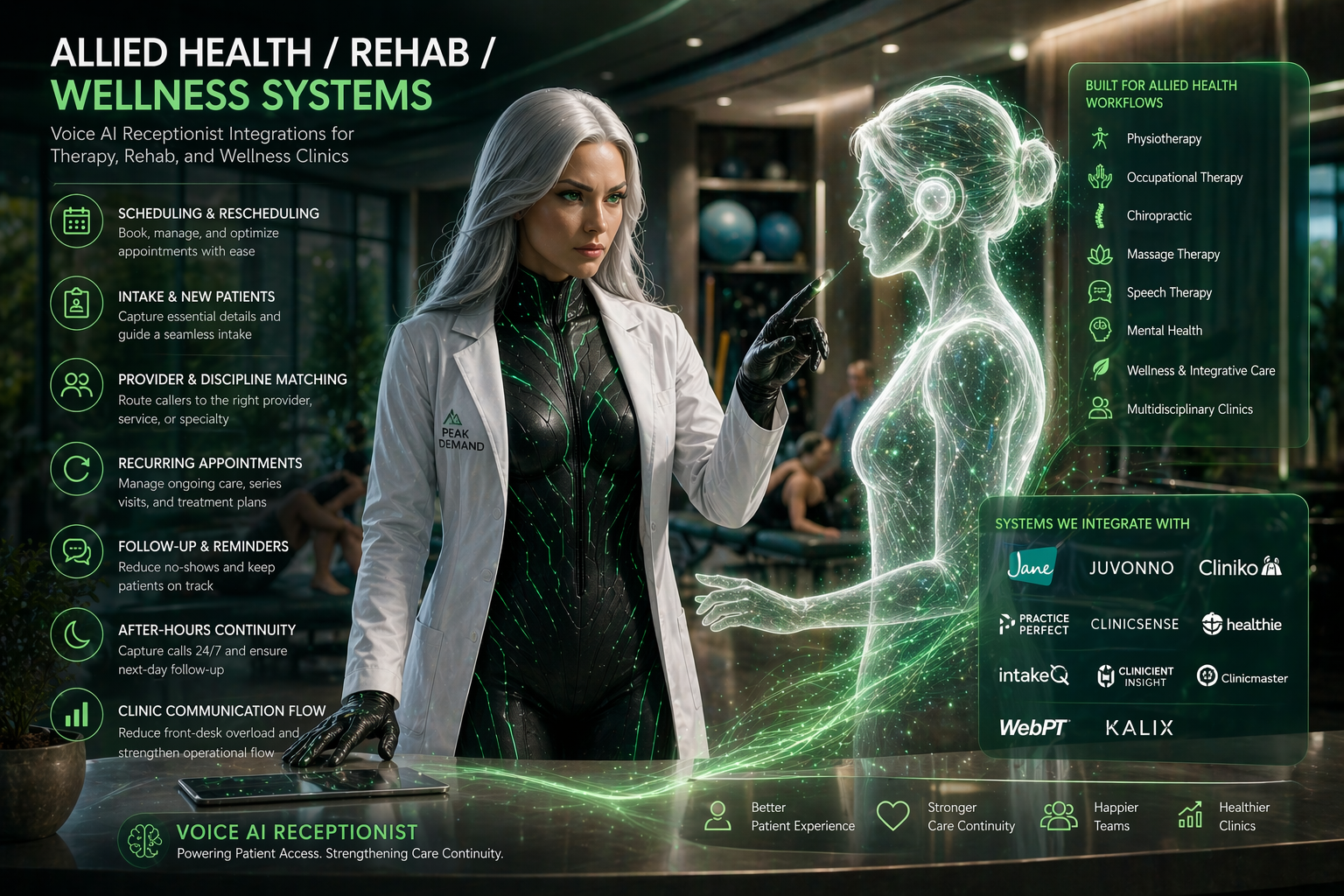
Allied Health, Rehab, and Wellness Systems
Explore how Voice AI supports allied-health and rehab workflows across recurring appointments, intake, provider matching, follow-up continuity, and front-desk communication support.
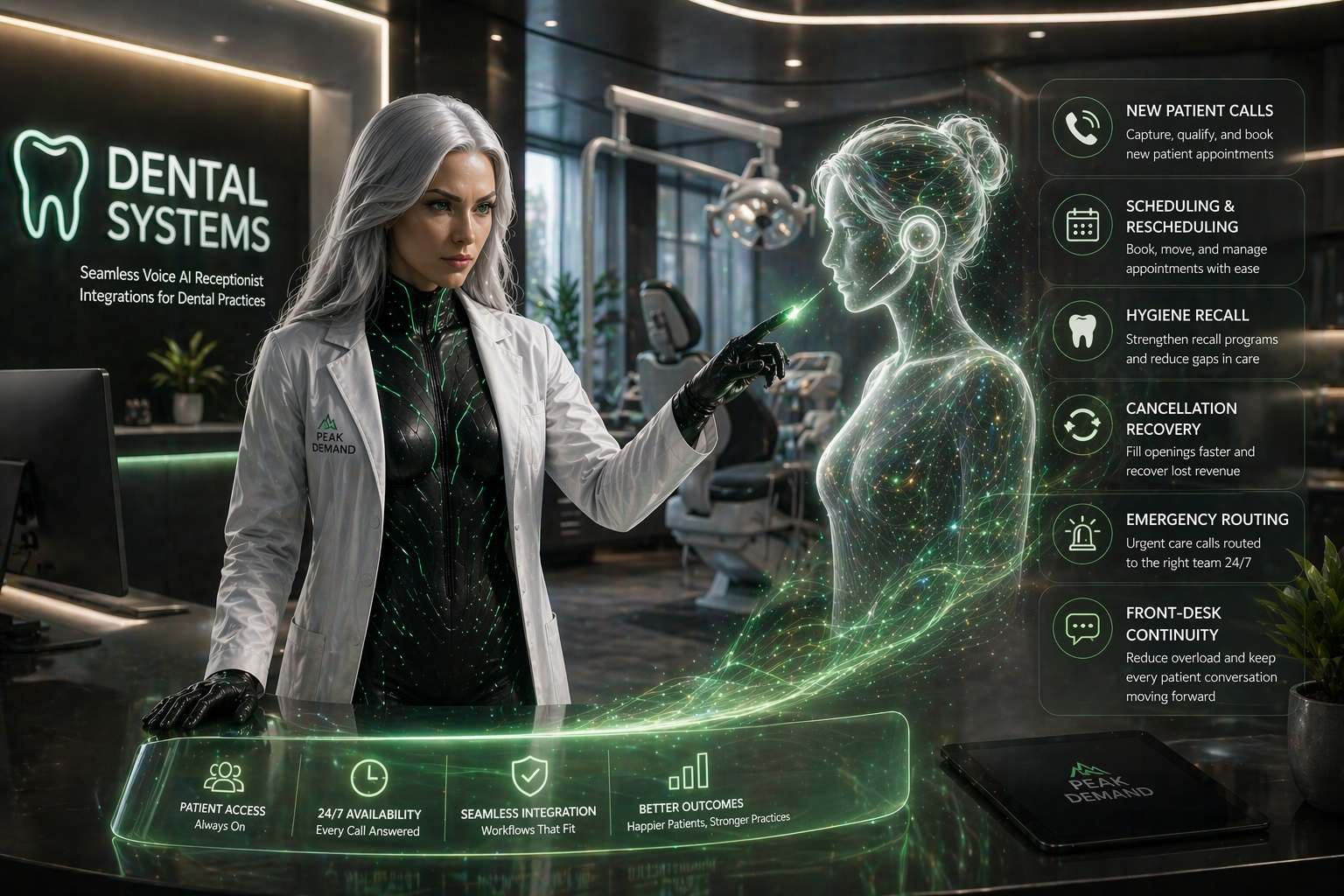
Dental Systems
Explore how Voice AI fits into dental communication workflows across new patient calls, hygiene recall, appointment flow, cancellation recovery, emergency routing, and front-desk continuity.
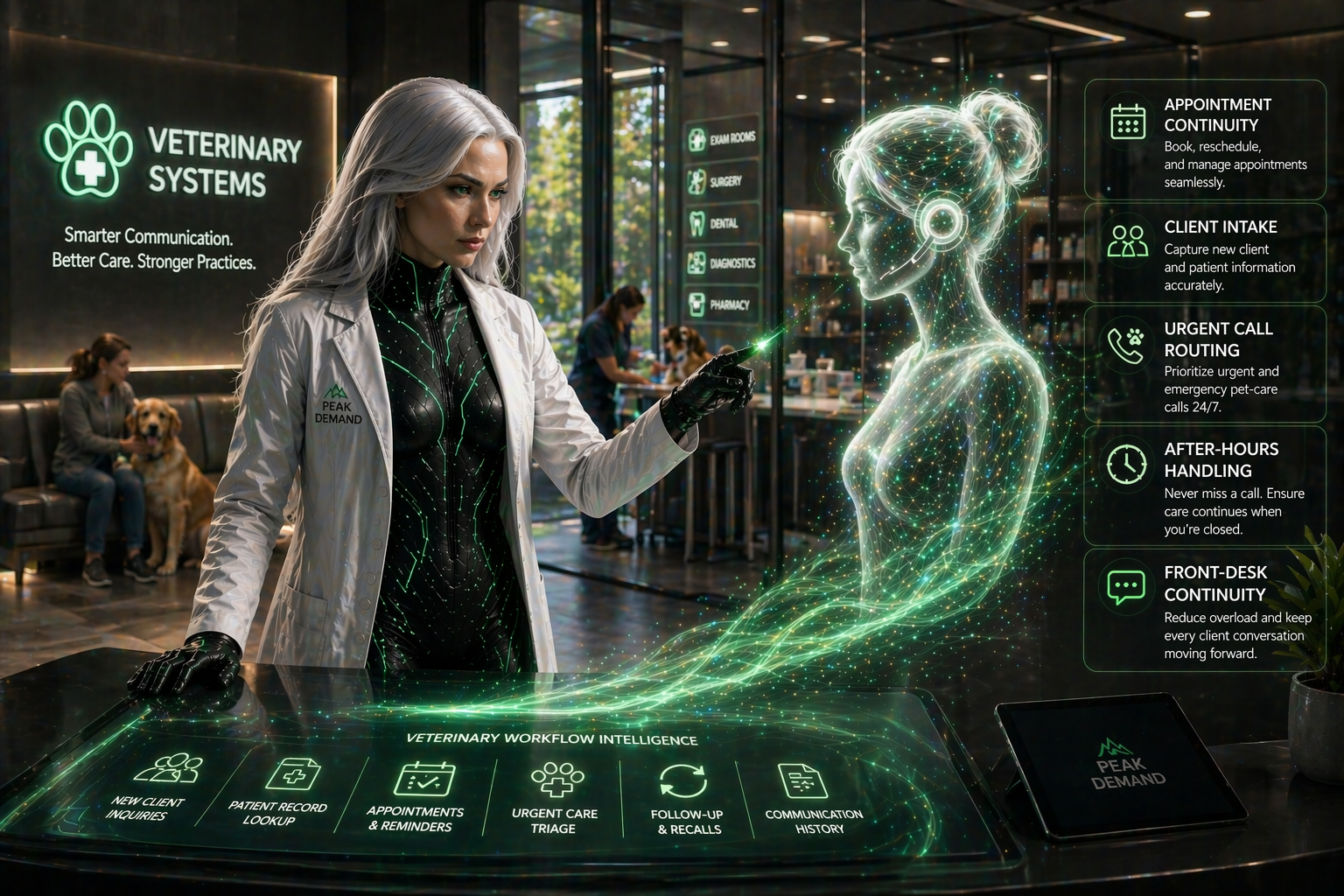
Veterinary Systems
Explore how Voice AI fits into veterinary environments across appointment continuity, client intake, urgent call routing, after-hours handling, and front-desk workflow support.
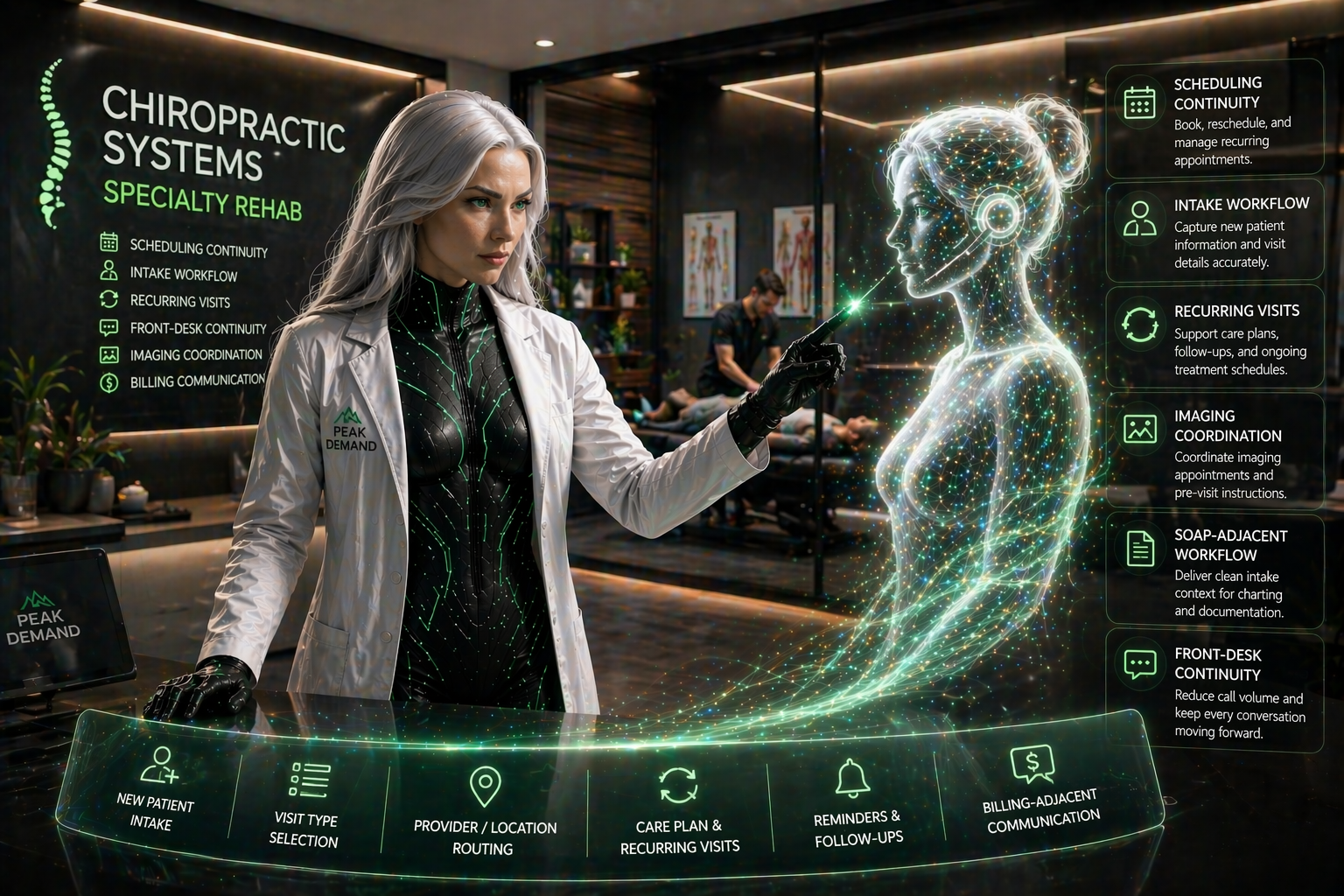
Chiropractic and Specialty Rehab Systems
Explore how Voice AI fits into chiropractic and specialty rehab workflows across scheduling, intake, recurring visits, SOAP-adjacent continuity, imaging-adjacent coordination, and front-desk support.
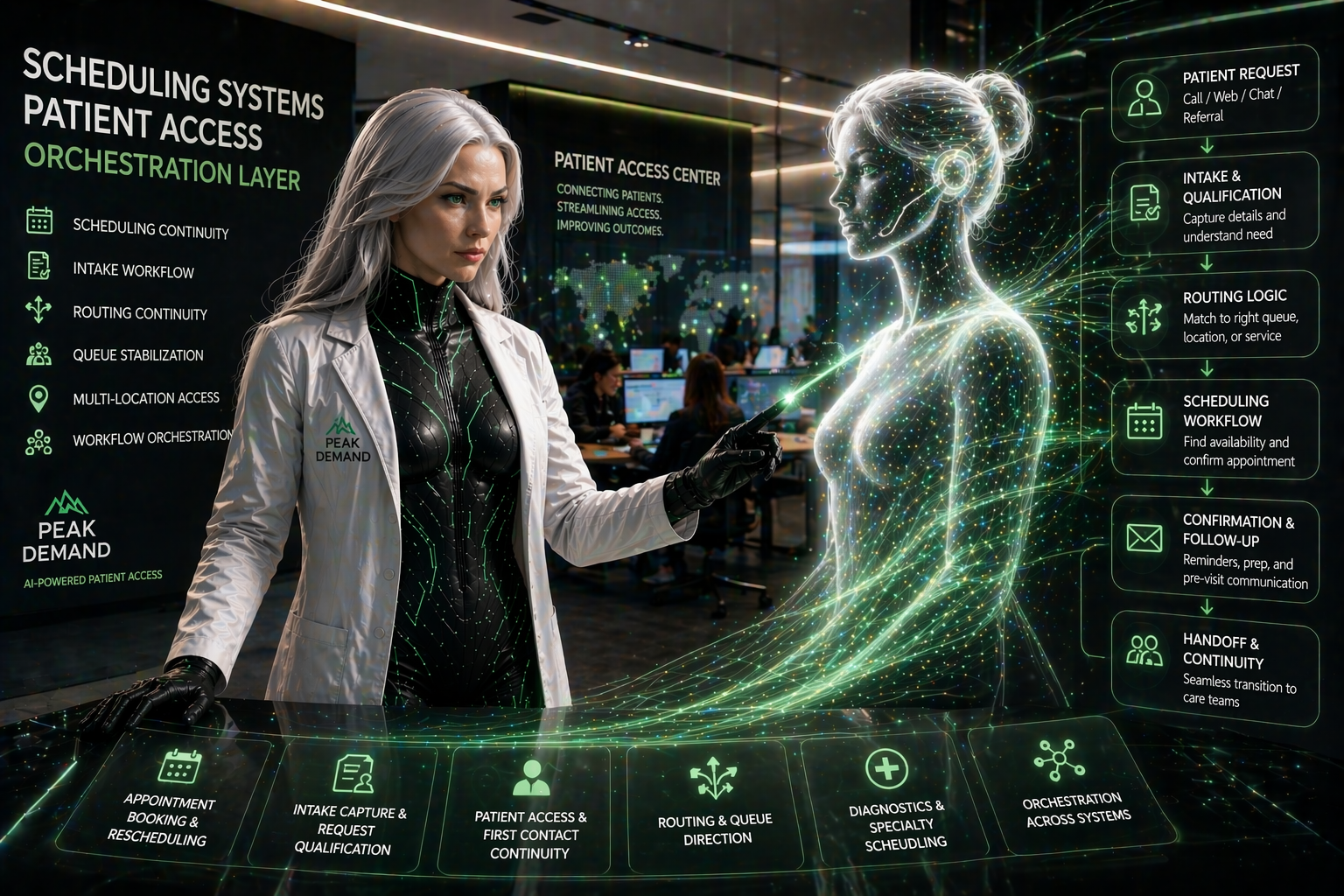
Scheduling, Patient Access, and Orchestration Systems
Explore how Voice AI supports scheduling and patient access architecture across intake, routing, queue stabilization, diagnostics scheduling, and workflow continuity between first contact and next action.
See Healthcare Voice AI Integrations In Action
These walkthroughs show how Voice AI can connect into real healthcare scheduling, intake, and communication environments. Start with TELUS Health CHR for Canadian clinic workflows and Juvonno for rehab and allied health operations.
TELUS Health CHR Integration Walkthrough
See how Voice AI can support TELUS Health CHR scheduling, intake, patient communication, and Canadian clinic workflow continuity.
Juvonno Integration Walkthrough
See how Voice AI can support Juvonno workflows for rehab scheduling, intake, appointment handling, and clinic communication continuity.
Explore published healthcare systems by name
Once you know the software family that best matches your environment, this section makes it easier to browse live healthcare integration pages by platform name. Each category below groups published system pages by the type of environment they usually support so operators, managers, and technical teams can compare workflow fit more quickly. A fuller alphabetical directory appears farther down the page.
Featured healthcare systems
These are high-priority starting points for visitors evaluating real-world Voice AI workflow fit across scheduling, intake, patient communication, routing, and access workflows.
Clinic, ambulatory, and medical EMR systems
These systems are commonly associated with clinic records-adjacent workflows, appointment flow, patient requests, intake continuity, routing, and broader ambulatory communication operations.
Scheduling, intake, and patient communication systems
These environments sit closer to booking logic, intake flow, reminders, clinic administration, and day-to-day patient access operations.
Rehab, physiotherapy, and allied health systems
Allied health and rehabilitation environments often depend on strong scheduling continuity, practitioner matching, intake flow, recurring appointment management, and multi-location operational coordination.
Dental systems
Dental communication workflows often center around appointment demand, cancellation recovery, reminders, new patient calls, and front-desk continuity across booked production.
Veterinary systems
Veterinary communication environments often require appointment continuity, client communication, after-hours handling, urgent call direction, and records-adjacent workflow coordination.
Healthcare organizations rarely evaluate integrations in a vacuum. Grouping systems by software family makes it easier to understand likely workflow fit, compare environments more quickly, and navigate toward both family-level integration pages and live system-specific pages deeper in this hub. The full alphabetical system directory farther down the page should carry the complete 98-system library.
Where Voice AI sits in the healthcare workflow matters more than basic connectivity
Healthcare Voice AI becomes more useful when it is treated as part of the larger workflow architecture around patient access, intake, routing, scheduling, escalation, and downstream ownership. The question is not only whether a system connects. The question is whether the communication flow reaches the next operational step with enough clarity and structure to reduce friction instead of shifting it downstream.
In practice, that means Voice AI often sits across multiple workflow layers at once. It may support first contact, gather structured intake, help direct the caller into the right path, preserve context for staff, and improve continuity into the next step. The value comes from how those layers fit together, not from one isolated connection point.
This is why healthcare teams should evaluate both the scheduling and patient access layer and the EMR or EHR-adjacent layer. In more complex environments, the architecture may also need to account for enterprise compliance and procurement requirements.
Where Voice AI usually enters the workflow
Voice AI often enters at the communication edge: inbound calls, appointment demand, intake capture, after-hours answering, overflow handling, and patient access or routing-related first contact.
Explore healthcare AI receptionistsWhere continuity usually breaks down
Continuity often breaks between the interaction and the next operational owner. That can happen when routing is weak, intake is unclear, scheduling context is incomplete, or downstream teams still need to manually rebuild the request.
Explore centralized scheduling workflowsWhat stronger integration architecture actually improves
Stronger architecture preserves enough structure, direction, and next-step usability for staff or systems to act efficiently. That is what turns Voice AI into operational infrastructure instead of a disconnected front-end layer.
Return to the healthcare resource hub| Integration maturity | What healthcare teams usually experience | Likely operational result |
|---|---|---|
| Fragmented | Some connection points exist, but scheduling, intake, routing, escalation, and continuity still require heavy manual repair. | Lower operational value, more staff burden, weaker patient access continuity, and less confidence in the workflow. |
| Partially connected | Important workflow layers connect, but structure and downstream usability still vary too much between teams, departments, or next-step owners. | Moderate gains, but persistent continuity gaps remain and staff still absorb unnecessary workflow friction. |
| Workflow-led and integrated | Voice AI supports multiple workflow layers with stronger structure, clearer routing, better handoff, and more usable next-step continuity. | Stronger patient access flow, cleaner operational ownership, and more scalable communication infrastructure. |
What healthcare teams should evaluate in the architecture discussion
- Where does Voice AI need to sit first in the communication workflow?
- Where does continuity currently break between the interaction and the next operational step?
- Which layers are EMR or EHR-adjacent, and which ones are workflow-adjacent?
- How do scheduling, intake, routing, patient access, and escalation interact in this environment?
- Will downstream teams receive enough structure to act without rebuilding the request manually?
- Is the integration design workflow-led or just feature-led?
- Does the current architecture reduce friction for staff, or does it simply move the work somewhere else?
Healthcare organizations usually get more value when they evaluate integration maturity across communication flow, operational ownership, and downstream usability together instead of treating each connection as a separate isolated decision. For system-specific evaluation, use the alphabetical healthcare system directory below.
Evaluating software families?
Use the six system-family pages to compare EMR, EHR, dental, veterinary, rehab, scheduling, and patient access environments.
Browse Software FamiliesEvaluating specific systems?
Use the full alphabetical directory to find the exact healthcare platform your team is evaluating.
Open System DirectoryEvaluating enterprise readiness?
Review governance, privacy, escalation, procurement, and compliance considerations before deployment.
Review ComplianceGo deeper into the strategy behind healthcare Voice AI integrations
This section helps healthcare teams move from broad category understanding into the right supporting resources for architecture, interoperability, workflow fit, implementation planning, and system-specific evaluation.
The articles below are the best next clicks for teams evaluating how Voice AI fits into healthcare communication systems, patient access workflows, structured integration pathways, rollout planning, and governed healthcare environments.
For broader category education, use the Healthcare Voice AI Resource Hub. For software-specific evaluation, continue to the full alphabetical system directory lower on this page and use the six healthcare software family pages as the parent layer.
Need system-family pages?
Use the family pages to compare medical EMR, allied health, dental, veterinary, specialty rehab, and patient access systems.
Browse Software FamiliesNeed a specific platform?
Use the alphabetical system directory to find the exact EMR, EHR, scheduling, dental, veterinary, or rehab platform.
Open System DirectoryNeed compliance context?
Use the enterprise compliance page when governance, privacy, procurement, RFPs, or regulated deployment requirements are part of the evaluation.
Review ComplianceCore integration strategy articles
These resources explain why integrations matter, what healthcare teams should evaluate first, and how stronger Voice AI integration architecture should be understood.
Custom pathways, structured integrations, and workflow fit
These articles are useful for teams evaluating custom pathways, structured communication flows, and how Voice AI fits into real healthcare operating environments.
Rollout, implementation, and governance
These resources are best for healthcare teams moving from early exploration into rollout planning, operational safety, implementation readiness, and governance-aware deployment.
Patient access, routing, and workflow bottlenecks
These articles help healthcare teams think more clearly about where communication complexity builds up across patient access, intake, department routing, scheduling, and downstream handoff.
As the healthcare integrations ecosystem continues to grow, this section can keep routing visitors into the most relevant strategy, rollout, and workflow resources without changing the overall structure of the hub. The full software directory appears in the Alphabetical System Directory section below.
Explore live healthcare system integration pages by category
This section gives healthcare teams a category-based way to browse the most important live system pages. It is not the full 98-system directory; it is a curated navigation layer for comparing the platforms most commonly tied to scheduling, intake, patient communication, routing, and patient access workflows.
Use this section when you know the type of software environment you are evaluating. Use the Alphabetical System Directory below when you want to find every live system page by name.
Need the family layer?
Start with the six parent family pages when comparing software categories before choosing a specific system.
Browse Software FamiliesNeed every system?
Use the alphabetical directory for the complete live healthcare system page list by platform name.
Open Alphabetical DirectoryNeed workflow context?
Review how Voice AI fits across patient access, intake, routing, scheduling, escalation, and downstream ownership.
Review Workflow ArchitectureFeatured healthcare systems
These are some of the strongest starting points for teams exploring healthcare Voice AI integrations across scheduling, intake, patient communication, routing, and access workflows.
Clinic and ambulatory EMR systems
These systems are commonly associated with clinic records-adjacent workflows, intake, appointment flow, routing, patient communication, and broader ambulatory continuity.
Explore medical and ambulatory EMR familyScheduling, intake, and patient communication systems
These environments sit closer to booking logic, intake flow, reminders, clinic administration, and day-to-day patient access operations.
Explore scheduling and patient access familyRehab, physiotherapy, and allied health systems
Allied health and rehabilitation environments often depend on strong scheduling continuity, practitioner matching, intake flow, recurring appointments, and multi-location coordination.
Explore allied health and rehab familyDental systems
Dental communication workflows often center on appointment demand, cancellation recovery, reminders, new patient calls, and front-desk continuity.
Explore dental familyVeterinary systems
Veterinary communication environments often require appointment continuity, client communication, after-hours handling, and records-adjacent workflow coordination.
Explore veterinary familyEnterprise, specialty, imaging, and outpatient environments
These environments often involve more complex routing, diagnostic scheduling, imaging coordination, enterprise workflow ownership, and department-specific handoff requirements.
Explore enterprise and medical EMR familyThis curated category browse section helps visitors compare common healthcare software environments without scrolling the entire directory. The complete system list belongs in the Alphabetical System Directory section below, where every live healthcare system page should be listed by platform name.
Talk through your healthcare communication workflow
If your team is evaluating healthcare Voice AI integrations, the most useful next step is usually a workflow conversation. That means reviewing patient access pressure points, scheduling flow, intake structure, routing logic, after-hours coverage, compliance expectations, and the systems surrounding those workflows.
Peak Demand approaches healthcare environments through workflow fit, governance awareness, and operational usability. The goal is to help organizations map a communication architecture that supports real teams, real workflows, and real continuity requirements across EMR, EHR, scheduling, intake, dental, veterinary, rehab, and patient access environments.
Need software families?
Compare the six parent healthcare integration families before choosing a specific system page.
Browse software familiesNeed workflow context?
Review how Voice AI fits across intake, routing, scheduling, escalation, and downstream ownership.
Review workflow architectureNeed compliance review?
Use the enterprise compliance page when governance, privacy, procurement, and RFP standards matter.
Review complianceFrequently asked questions
What does Voice AI mean in a healthcare integration environment?
Can Voice AI work with EMR, EHR, scheduling, intake, and routing workflows?
Are healthcare Voice AI integrations always direct?
Where should healthcare organizations start evaluating Voice AI integrations?
How should compliance and governance fit into the evaluation?
What is the role of this integrations hub?
About Peak Demand
Peak Demand is a Toronto-based AI agency focused on Voice AI, communication automation, and workflow infrastructure for organizations operating in more complex service environments.
In healthcare, the focus is not just on call handling. It is on patient access continuity, scheduling pressure, intake structure, routing logic, after-hours support, governance, and how communication systems fit into real operational workflows.
- Workflow-driven and implementation-aware
- Governance-first in healthcare communication environments
- Built to support clinics, networks, and enterprise teams
- Designed to scale into software-specific integration pathways
- Organized around healthcare system families and live integration pages
Healthcare software integrations by system name
If you already know the software you are evaluating, this alphabetical directory is the fastest way to find the right live system page.
This directory includes the full 98-system healthcare integration library from the current Peak Demand system-page build. It is designed to help teams compare EMR, EHR, scheduling, intake, patient communication, dental, veterinary, rehab, wellness, chiropractic, orchestration, home care, med spa, pharmacy, and enterprise healthcare systems by software name.
For category-level browsing, use the software family section. For workflow context, use the workflow architecture section. This section is the full alphabetical browse layer.
Live healthcare system pages in this directory
Grouped alphabetically with visible section counts so the full library is obvious at a glance.
A–C
34 systemsABELMed through Curve Dental.
D–H
20 systemsDentrix through Helios Software.
I–M
15 systemsIDEXX Cornerstone through MRX Solutions.
N–O
11 systemsNextech through Owl Practice.
P–R
8 systemsPabau through RXNT.
Compare healthcare systems by name, category, and workflow fit
This directory is useful for comparing clinic EMRs, EHR-adjacent systems, scheduling and intake platforms, patient communication software, dental systems, veterinary systems, rehab and allied health systems, chiropractic systems, med spa systems, home care systems, pharmacy-adjacent systems, orchestration platforms, diagnostic workflows, and enterprise healthcare environments by software name before going deeper into workflow design, integration possibilities, and operational fit.
Explore your own AI use case on a discovery call.